Friday, April 10, 2020

Review: In Darkest Warrens Ultimate Edition


I have been following the work of Scott Malthouse for a few years now and I have been really impressed with his work. You can find his blog and website here. I was introduced to his games during my transition away from overly complicated games and In Darkest Warrens was one of the first games I picked up. When I saw the Ultimate Edition I was really excited and I picked it up right away. In Darkest Warrens: Ultimate Edition bills itself as "Minimalist Fantasy Roleplaying".

The Ultimate Edition is a revised version of the original release that provides a sharper layout, clearer language, and expanded rules. It also includes a lot of information found in two of the original supplements that were released shortly after core rules. 

Presentation: The entire game is packed into a neat five page PDF that includes the cover. The cover is formatted in portrait and the remaining pages are formatted in a four column landscape. These remaining pages include two pages of rules (includes a sample adventure), one page for a Referee Guide, and one page for a built in setting/town staring point called Darkholme. It also includes some evocative black and white art.

Character Creation: Character creation follows a few simple steps:

  1. Assign Attributes: Assign 5+, 4+, 4+, and 3+ to the attributes of Brawn, Nimble, Mind, and Person. 
  2. Choose a Class: The choices are Warrior , Rogue, Mage, Ranger, and Barbarian. Each class has a single ability that can be used once per combat but the effectiveness of these abilities scale with level. The class choice also determines starting wounds that range from 3 to 6.
  3. Roll 1d6x10 for starting gold. 
  4. Write down some interesting things about the character.
Resolution:  The core mechanic comes down to a single roll of a d6. The players roll against their relative attribute of Brawn, Nimble, Mind, and Person. If the result is equal to or greater then their rating; the character succeeds, if not the character fails. Adversaries attributes are condensed into a single rating (3+, 4+, etc) and they usually have a special rule or two. When an adversary is trying to attack or take an action that would require a roll then the GM rolls against their single rating. An example monster entry looks like this:

 Skeleton: 4+, 5 Wounds, blunt weapons take a -1 to attacks against the skeleton.

Tests (for everything - including saves) are made against the characters attribute can be easy or hard which gives the single d6 roll a -1 or +1 respectfully.

Combat follows after initiative which each player tests Nimble and those who pass act before the enemies and those who fail act after the enemies. Each character can take two actions a round - one movement (or equivalent action) and one attack action. All types of attack deal 1 wound in damage and armor adds a buffer of additional wounds.


Crunch: There is not much crunch outside of the universal d6 roll. I would like to mention a few things that was not mentioned during the resolution section.
  • Advancement works off of experience points. Characters can gain 1-5 XP for killing monsters, completing quests 5 XP, and great roleplaying 2 XP. A character levels up when they reach 20 XP times their current level. When a character levels up they gain two wounds.
  • Spells are able to be used once per combat and once per hour out of combat. The Mage has access to three spells; Hold, Heal, and Hex.
  • Traps work off of two different rolls. The first one being a roll for the character to notice the trap. The second roll is the traps "attack roll" based off of their rating just like a monsters. 
  • Advanced Options adds more depth to combat and include options such as Defense, Flee, Trip, Hold, and Unarmed Combat. These options also go into status effects like poisoned, paralyzed, stunned, pinned, diseased, prone, and frightened. 

Final Thoughts: Before I give my concluding thoughts I want to give a shout out to the Referee section. This one page gives a lot of tools the Referee can use to help add to the game. It includes traveling, mounts and vehicles, weather, light levels, breaking objects, encumbrance, traps, and player races.

In Darkest Warrens sets out to be a smooth minimalist fantasy roleplaying experience and it accomplishes this task with flying colors. I have ran the original release of this game on multiple occasions. Most of these games have been one shots but I also ran a sixteen session campaign with it. I am also currently in a play by post game using the Ultimate Edition.

Some of the high points for me are:

  • The traps. I love how the Traps in this game basically have an attack roll. It is to see if the trap springs correctly and it just makes thematic sense. Especially in old castles and tombs.
  • The race choices provide a thematic ability instead of any type of attribute bonus. It makes choosing a race more of an aesthetic choice then a min/max choice. 
  • The resolution system is fun. Reminds me of my wargaming days. 
  • The implied setting is really evocative.
I do find it interesting that Mages do not have a "Harm" spell or a way to deal direct damage. Though the magic level could be more Lord of the Rings then Dressen Files. 

All in all In Darkest Warrens is rules light enough to keep immersion strong but has the depth for extended campaign play.

You can find the PWYW pdf here but I would highly recommend supporting the author and throwing him some coin. 

Thursday, April 9, 2020

Chronicles of Neverwhere: Bladesingers


The curse has effected the Dwarves and the Elves the most. It has left their once great empires in ruins and survivors of these once great peoples are scattered throughout the land. It is sad but the survivors fall into one of two camps. The first camp being the curse has twisted their mind as well as their body and they become cannibalistic tribes that only only exist for the hunt. The second camp of survivors is curse has left them with their sanity (to varying degrees) but in most major settlements the twisted are treated poorly and forces to live in horrible conditions. 

Though, of the Elves that have kept their minds (or at least parts if it) they remember the ancient art of Bladesinging. This memory has created a desperation to make sure their culture (or at least aspects of it) survive the curse and the white. So, these elves set out to train others in the way of Bladesinging. Some of them travel to look for students while others set up "monasteries" in villages or in a dingy back room of some derelict building in one of the major settlements. Some of them even risk the hermit life in the white at let rumors of what they can teach send them possible students and surviving to find them is part of the initiation. 


The fancy PDF* can be found here

 *This was made possible with the input and amazing formatting skills of Vance A. His blog can be found here. I recommend giving it a read.

Sunday, April 5, 2020

Review: Troika!


"HOLY LSD INDUCED FEVER DREAMS BATMAN!" - Robin

So, this kind of sums up my excitement over Troika!


I have to say that this game took me by surprise. From my understanding it is a hack inspired by Fighting Fantasy and British 80's role playing games. The cover alone invokes such interest and curiosity I do not know how anyone seeing this in a shop or online could not be drawn to it.

"Imagine, if you will, that Douglas Adams and Terry Pratchett have returned from the dead.They both pile into a Ford Cortina and take a long drive across the American Southwest,pondering the nature of the fantasy genre. Once they arrive in California, they legally acquire several ounces of the finest cannabis sativa and hotbox the Cortina. Then they write an RPG. This, roughly speaking, seems to be what produced Troika, a delightfully simple and delightfully absurd game." - Aaron Marks

"There is more flavor in one paragraph of this than in a dozen OD&D knockoffs." - Gary M.

I have to agree with the words above. This game is a breath of fresh air and just reading it puts the imagination into overdrive and it is just enjoyable to read. 

Presentation: The book is an A5 hardback that clocks in at 109 pages that are full color. The typeset is set on a background of colored pages that remains easy to read. Then art is a mix of full color, black and white, and psychedelic line art. It really invoked a weird and gonzo idea of a setting where anything can happen. The art really makes the book enjoyable to flip through. 


Character Creation: This is actually the most fun I have had during character creation in a long time. Lets see what I roll up:

  1. Roll 1d3+3 to Determine Skill (4)
  2. Roll 2d6+12 to Determine Stamina (20)
  3. Roll 1d6+6 to Determine Luck (8)
  4. Record baseline possessions that all characters start with (2d6 Silver Pence, a Knife, A Lantern and a Flask of Oil, a Rucksack, and 6 Provisions)
  5. Roll d66 on the Background Table and record Possessions and Skills (rolling for or choosing a background is where I think the game really takes off)

Finally, fill in the usual origin story stuff to give your character some more life. 

Resolution: As you saw in character creation, this is a rules lite game but the mechanics are solid. 

Roll Under when Unopposed:
  • 2d6 under/equal to your skill*
  • Climbing, lifting, casting spells, etc.
  • 6,6 us always a fumble/failure
Roll Versus During Contests:
  • 2d6 + your skill VS. their 2d6 + skill*
  • Combat, Racing, arguing, searching, etc.  
  • 1,1 is a fumble/failure
These include advanced skills which are skills like Great Axe Fighting. These are added to your base skill level for the 2d6 roll.

Fighting and Not Dying:
  • Melee - Roll Versus, Higher wins and deals damage. 6,6 deals double damage. 1,1 fumble, suffer +1 DMG. 
  • Shoot - Roll Versus thier evasion/Skill. If you shoot into melee random targets. If you take an AIM action, on next turn roll twice and take the best roll. 
  • At 0 Stamina you die at the end of the round
  • Under 0 Stamina, you are dead usually. Luck Roll?
  • 8 Hours rest, regain 2d6 Stamina and 2d6 Luck
  • Provisions regain 1d6 Stamina (max 3 times per day)
Cast a Spell
  • Requires one free hand and the ability to speak. 
  • All spells have a Stamina cost. Spend the required Stamina and roll under your skill. Success then the spell happens. Failure nothing happens, and on a fumble roll on the mishap table.
Luck
  • Luck functions of a save vs. effect mechanic in addition to of a character does something that is completely crazy and off of the wall. Roll under your luck to succeed or for reduced/no effects. Luck is reduced by 1 regardless if the roll us successful or not. 


Crunch: Resolution sums up most of the mechanics but the crunchiest bit is the initiative system. Basically, the GM assemblies a bag of tokens. Each PC gets 2 tokens (all all PCs are color coded) then the NPCs get tokens equal to their initiative, and there is an End of the round token. If the end of the round token is drawn, all the tokens are put back into the bag and a new round begins. This system makes combat extremely random and deadly as enemies tokes greatly outnumber the PCs because enemy tokens are based initiative. Take Lizardmen for example, they have initiative 2 so if the party fights four of them, that is 8 tokens. There is an optional rule listed about limiting enemy tokens. 

Troika also makes a player roll to retrieve something out of their bag. This also adds an random element in the heat of the moment to see if what the character needs is at the top of their bag. 

This game also possesses a simple encumbrance system. All characters have 12 slots of inventory. Above 12 slots the character starts suffering encumbrance penalties. Large Items take 2 slots (Heavy Armor takes 6), all regular items take one slot. Ammo and other things is considered one slot unless a character is carrying a lot of said item.

The last aspect I have not mentioned is how Armor and Damage Works. Each weapon has an damage table. When you land a hit, you roll a d6 and consult the table for that weapon. The higher the roll does more damage and there is a 7+ box just in case you have a bonus or some type of magic or ultimate weapon. In contrast, Armor comes in ratings of -1,-2, and -3. Shields add an additional -1. Armor reduces the result of the d6 damage roll to a minimal of 1.


Final Thoughts: This game has really impressed me. Even before I read through the book - the cover, the artwork, and the layout just gives this game so much flavor and soul by itself. Then when I read through it? Truly a mind bending experience. It does not come right out and explain a setting but all of the backgrounds and other information provide a strong implied setting that can either be used or just minds for ideas. This game even makes me like things I usually do not like such has paying stamina to cast spells (one of the reasons for this is the costs are modest and seem fair/balanced). It is becoming one of my favorite games and if my upcoming campaign was not already built on The Black Hack 2e then I would switch over to this in a heartbeat.

I think the initiative system is over complicated and leans in the favor of the adversary. I wish the book would have included an alternate initiative system or a token system that does not favor the adversary so much. There is a Initiative Deck but it is sold out on the website and currently not available through drivethrurpg.

Though, I think the game double dips into the myths that haunt the OSR about character weakness. This weakness comes from the low stamina and high damage plus the obscenely lopsided initiative system. These things are easily house ruled and does not tarnish my love for this game.


You can find Troika! and other Support for it at these places (Please note that the current print is sold out and there is a reprint in the works, which you can preorder):
Another bonus that is becoming my favorite thing that game designers are doing is turning the inside covers into a GM screen. 

Thursday, April 2, 2020

Mythbusters: OSR Edition


Before I start on the topic at hand I want to say that I am a huge fan of what the OSR movement has done for the hobby (and me as some of my favorite games fall under the OSR and it has helped me become a better GM) of role playing. We have seen countless rules light games with various innovations, numerous retro-clones, and a ton of DIY games and variations on existing systems. I think the most important aspects to come out of it is a focus on role playing and not roll playing (a lot more player agency with a narrative driven mindset) and an interest in all of the other founders of the hobby and how they played (Dave Arneson, David Wesely, etc). I would be remiss at this point not to mention the Secrets of Blackmoor Documentary which explains the true history of Dungeon and Dragons.

This is also one of my favorite aspects of the OSR movement...


Even with all of these amazing things going on in the hobby in regards to the OSR and what the OSR has inspired there are myths that are taken as gospel which hang over the OSR like the Mists of Ravenloft. The core of these myths revolve around the game being made extra deadly by way of weak characters (this is in addition to the encounters, lack of built in snowflake abilities, monsters, resource management, etc). I have already talked about my ideas regarding pointless POINTLESS character death here. Cavegirl makes a great argument regarding how character death can be liberating and I agree with her up to the point that the death should be with purpose, meaningful, heroic, or at least a learning experience for the player. The learning experience angle is becoming one of my favorites because as Cavegirl points out, players will quickly learn that they can't and shouldn't solve every problem by hitting it with an axe, will become better at resource management, and take a more all around mindful approach to all situations. Though, I do not think character death is liberating when it is a constant march into a meat grinder.


These myths are perpetrated mainly by two ways...

1. 3d6 in Order: This method for rolling stats is common across the board. There are a handful of games today that will have an optional rule blurb about rolling 4d6 and dropping the lowest or an array. I am not sure where this myth started and how it has taken such a powerful hold on the OSR movement. In the AD&D 1e Dungeon Master's Guide (this book is considered the Holy Grail by many across the role playing hobby regardless of genre and is a must have/read) Gary Gygax's writing states that PCs in Dungeons and Dragons should a "viable character of the race and profession which he or she desires". Gary goes on to discuss that it is possible to generate a playable character by rolling 3d6, but only after "an extended period of attempts at finding a suitable one due to the quirks of the dice". Creating and playing characters is one of the best aspects of the game and the characters should be heroic, not peasants with pitch forks. the AD&D 1e Dungeon Master's Guide goes on to list different methods for generating ability scores:

  • Method I: All scores are recorded and arranged in the order the player desires. 4d6 are rolled and the lowest dice is discarded. 
  • Method II: All scores are recorded and arranged in the order the player desires. 3d6 are rolled twelve times and the highest six scores are retained. 
  • Method III: Scores are rolled according to each ability category in order: Strength, Intelligence, Wisdom, Dexterity, Constitution, and Charisma. 3d6 are rolled six times for each ability and the highest score for each ability is retained. 
  • Method IV: 3d6 are rolled to generate totals for each of the three ability scores in order. This is done twelve times in a row (basically making twelve different characters) and the player selects which set of six scores to use. 
  • Method V: This method actually appears in Unearthed Arcana 1e. The player chooses the class first and then roll on attributes that were most important to least important. So, the player would take the stat that was most important and roll 9d6 taking the three highest results and adding them together. This method would be done for each stat but subtracting 1d6 for each stat rolled. So, the second most important stat would be 8d6 (adding the three highest results) rolled and so on until you get to the least important state and rolled 3d6. If you do not get the prerequisite minimum for your class, you take that minimum. This is actually my current favorite method and I cannot wait to be able to use it. 
Nowhere in there is 3d6 in order. This method appears to be for commoners and people of little or no renown. Gary talks about how named NPCs should have high stats but general characters should be average. Gary goes on to recommend that when using 3d6 in order for general population commoners results of one's should be treated as three's and sixes should be counted as fours.

For normal commoners to save time, I would just use an array personally.


2. Low Hit Points/Dice: Low hit points or dice is another common theme across the board. This myth took hold at the beginning of the movement and it has been perpetuated since. I think this myth was born out of three ideas/issues. The first one being a mindset of "that is the way it has always been done and I will do it that way". The second one being that Hit Points were originally envisioned as literal vitality and meant to how much physical damage a body can take. Gary Gygax reinforced this idea by stating:

"It is quite unreasonable to assume that as a character gains levels of ability in his or her class that a corresponding gain in actual ability to sustain physical damage takes place. It is preposterous to state such an assumption, for if we are to assume that a man is killed by a sword thrust which does 4 hit points of damage, we must similarly assume that a hero could, on the average, withstand five such thrusts before being slain! Why then the increase in hit points?..."
I think this what people have latched on to for the most part. A lot of people don't include or focus on what Gary went on to say (or it was lost in translation):

"...Because these reflect both the actual physical ability of the character to withstand damage – as indicated by constitution bonuses- and a commensurate increase in such areas as skill in combat and similar life-or-death situations, the “sixth sense” which warns the individual of some otherwise unforeseen events, sheer luck, and the fantastic provisions of magical protections and/or divine protection. Therefore, constitution affects both actual ability to withstand physical punishment hit points (physique) and the immeasurable areas which involve the sixth sense and luck (fitness)."
Though because both ideas about hit points is part of the same statement people who don't focus on the first part take it as hit points should represent both vitality and luck/stamina/sixth sense. This is partly why HP levels, HD, and HD pools rarely change. Honestly though, who ever really enjoyed the d4 wizard? Or the super strong Conan style warrior that gets taken down by a lucky roll from a single orc?


The idea of hit points being vitality at all is outdated while hit points being purely luck/stamina/sixth sense makes a lot more sense. The latter also gives combat an idea of fluidity of parries and strikes instead of taking turns hitting a a stationary target.

The third idea is not an issue but more of how there is a lot of retro-clones in the OSR. These retro-clones want to try to stay as true as possible to the original material for compatibility. These retro-clones usually reorganize and redefine rules in addition to adding additional rules or changing how various rules interact. This is something I understand but it does not add much more word count to add a sidebar explaining this is how it was originally described and then using more modern innovation or vice versa. I know I mentioned compatibility earlier and I would like to point out that even the more innovative games int he OSR movement (such as White Hack, Black Hack 2e, Heroes Journey, etc.) are highly compatible with most other OSR games and adventures.

Before we discuss ideas how to adjust the hit points we must look to the philosophy of how hit points evolved:

“When we tried to use the old matrix rules (for CHAINMAIL™) only one die decided combat.  So either the player would die or the monster would.  Well, the players didn’t like that, so that’s where I came up with hit points….”  Dave Arneson, Gamespy interview by Andrew S. Bub August 2002.
Even if we look to modern editions of Dungeon and Dragons and other related games we still run into the same problem but the blows from the problem is softened. Regardless, even in 5e or Pathfinder 1e/2e the first couple levels characters are still really squashy and they are one crit or trap away from a new character.


So, thinking outside of the box is a must here. There is one thing that must be understood and applied to everything else we are going to be discussing and that one thing is hit points are not about vitality but are representative of luck and stamina. There are some people that have basically deemed them plot armor and I love that concept and what it invokes. With that being said, down the rabbit hole we go:

Ideas from Original Theories 
From my research and understanding Dave Arneson preferred a system where hit points were more static and did not improve as characters gained levels or they slowly improved. Then you have some of the board and other war games that inspired David Wesely.

  • Looking to Gamma World 1e, the hit points in that game did not improve. Usually your hit points were figured out by the characters Constitution Score x d6. I really like this idea but the d6 is to swingy and you can end up with characters that have 17 hit points or 102 hot points. I would take the average here and rule Constitution Score x3 or x4. That flattens the curve.
  • Scrap hit points all together and use a wound system. Barons of Braunstein, Blood of Pangea, West End Games d6 System, and any iteration of the Storyteller System are good places to look for inspiration. I really enjoy the Blood of Pangea/Barons of Braunstein model - starting characters have 10 wounds. Successful attacks do 1 wound (or 2 with a two handed weapon) and critical for an addition loss of a wound. Additional wounds are gained slowly as one increases in experience as most armor now adds additional wounds. 
Ideas from Modern Evolution
These next couple of ideas are going to build from the common system of hit dice and their interaction with hit points (gaining a new HD every level, rolling it, and adding it to your total). We also have to understand games that have you re-roll HD every level and stop giving you HD by mid progression are not effective at curving the low hit points problem. Before I even go into options, I am going to give a shout out to games like Pathfinder (Pathfinder had a baked in rule where you could take half HD+1 as your result instead of rolling)and Dungeons and Dragons 5e (5e has max HD + Constitution modifier baked in) because they finally got rid of the d4 wizards and the other low hit dice classes and threw on various systems to curve low hp. So, we are going to use base idea of casters (wizards/sorcerers/warlocks) have a d6, all other hybrid classes (Druid, Cleric, Rogue, Monk, etc) have a d8, and the martial classes (Fighter, Paladin, Ranger) have a d10.

Even with using a common house rule of MAX hit points at first level the character is squishy. To be honest, characters really do not get their sea legs until level 3+. The most efficient and straightforward way to handle this style is what follows:
  • Starting Hit Points is Calculated by max HD + Constitution. In subsequent HD rolls, martial classes re-roll 1s and 2s while all other classes only re-roll 1s.
  • Starting Hit Points is Calculated by 10 + max HD. In subsequent HD rolls, martial classes re-roll 1s and 2s while all other classes only re-roll 1s. This alleviates Constitution being a power stat and players will not feel as forced to place high attribute ratings in Constitution. This method also gives some early hit point disbursement between the classes. 
  • Starting Hit Points is a static number - 12 or 15. In subsequent HD rolls, martial classes re-roll 1s and 2s while all other classes only re-roll 1s. This method allows all characters start on an even playing field and hit point disbursement becomes more apparent as the characters level up

3. Honorable Mention - "The One True Way": This does not fall into one of the main two ways but deserves a mention. There are people or groups of people in the OSR community that are very loud and obnoxious about how games have to be a certain way/follow certain patterns/must have rule X,Y, and Z to be considered OSR. Anything that does not fit their idea of what is OSR is met with great resistance and spite. These people basically cause edition wars within something that is not an edition or a single but something that is intellectual and spiritual in style. Look, everyone can play what they want and how they want. They can even have civil and theoretical discussions about it, but when it becomes a war band and these people/person(s) maliciously attack people who disagree with them or create an environment where it sours old and new players alike is when it becomes a problem. I consider peoples preferences on game styles or editions like a penis - it is alright to have one and it is alright to be proud of it but when you start waving it in my face is when it becomes a problem. I am sure at this point you are wondering, what is the mythbuster here? There is no one true way to play.

Let's face it. Characters should be heroic! Even if they are scoundrels (instead of the usual Superman ideology) because they are not and should never be a common peasant with a pitch fork guarding the chickens. Characters are made of tougher stuff and are meant for legendary things. For the love of the Dice Gods, let your players create actual heroes. Because honestly, they are going to do stupid things, run into some serious bad luck, not retreat when they should, and solve problems with their axe when it is not warranted. This coupled with the encounter style and low healing of the OSR is going to lead to plenty of deaths, but these deaths will not be pointless and they will be liberating! Higher attributes and a handful of extra hit points are not going to change this.

Sunday, March 29, 2020

Chronicles of Neverwhere: The Hunter


In the last couple hundred years various family lines have become known for their ability to hunt the monsters that lurk in the darkness and have turned "hunting" into a family business. Each new generation is trained in the arts of hunting. 

It is interesting to note that beings known as the Watchers have selected people across the lands to become hunters as well. These ethereal beings select those who the deem worthy and imbue them with the ability of the Hunters. 


The PDF* can be found here. 

 *This was made possible with the input and amazing formatting skills of Vance A. His blog can be found here. I recommend giving it a read.

Thursday, March 26, 2020

Regarding Character Death


This has been a topic that has been on my mind for sometime now - especially since discovering old school games and being a believer in the rules light/player agency philosophy.

I know personally when I make a character there is effort put into it in regards to the background and personality traits of said character. Even if it is just a paragraph or two. None of my characters are ever only a soulless collection of numbers and a list equipment. Even if I decide to let my character develop more in play in regards to both personality and background I still jot down a few bullet points. In my experience a lot of players have a similar mindset when creating characters. 

So, when a character dies a pointless death it sucks for the player, can cause angst with the other characters, or send some ripples in the story depending on how meshed the last character was in the plot lines. This is in addition to how a pointless death could drive new players away from the hobby. By a pointless death I mean some thug getting lucky in the alley, a random critical, fall off a two story roof, etc. The list can really go on and on.

Do not get me wrong, I have not problem with character death's when they do something stupid (I recently read a play report about a character in a dungeon running into the unknown parts of a dungeon to get away from some Golems he triggered.....), start a fight with things they should not have, not retreating when they need to, a run of bad luck (the part was climbing a cliff and had rope. The Kobold character was at the very top and slipped - failed the roll, each of the five other characters he passed failed their rolls to catch him, the koboold failed a last grab for the end of the rope, and failed a grab for a bush. Needless to say the Kobold did not survive the sudden stop.), or play through a scenario that is over their head. In these situations, GM's should not pull punches and let the consequences play out when the character pokes the bear.


"It is a perfect organism whose structural perfection is matched only by its hostility. It's a survivor, unclouded by conscience, remorse, or delusions of morality. I won't lie about your chances...but you have my sympathies." - Ash, Science Officer of the Nostromo
With that being said, I still think those well earned or deserved deaths should happen with a purpose. The character should be injure what they are fighting, be able to yell out an important clue to their other party members, advance the situation a tad, or in some way enjoy a decent heroic death - even if it was a stupid death.

The creator of Gamma World has some input on character death as well:


What happens when the character hits 0 hit points and they are suppose to be dead or dying (and you don't want to use RAW)?


I have come across some really great options to give characters a chance to survive as they are laying on the dungeon floor, fading in and out of consciousness, as they watch their fellow party members fight on. There are not in any order;

  •  Cavegirl did an amazing post on her blog about playing chess with death. I think this adds a lot of flavor to the situation and the world. Plus, it allows the GM to run death as an NPC with a personality. Ever since reading Terry Pratchett's Color of Magic I have viewed and treat the character of Death with that type of flare. 
  • Dungeon World has a Last Breath mechanic that kind of ties into the above option and you could use both together. "When you’re dying you catch a glimpse of what lies beyond the Black Gates of Death’s Kingdom (the GM will describe it). Then roll (just roll, +nothing—yeah, Death doesn’t care how tough or cool you are). On a 10+ you’ve cheated death—you’re in a bad spot but you’re still alive. On a 7–9 Death will offer you a bargain. Take it and stabilize or refuse and pass beyond the Black Gates into whatever fate awaits you. On a miss of 6-, your fate is sealed. You’re marked as Death’s own and you’ll cross the threshold soon. The GM will tell you when."
  • There are the various death and dismemberment tables out there. The way the work is, once you hit zero hp you are down and out of the fight. Any damage past that you have to roll on a death and dismemberment table. One of my favorites is the table from The Glog. Though, the one I currently use is this Crittable or "On a Table for Avoiding Death". It is a lot of fun and I just use the simpler option listed in it (roll 1d6 + negative HP damage and consult the table). 
  • I was part of a fantasy LARP many moons ago and when a character died they had you draw from a bag that had beads in it. If you drew a white bead you survived but were injured and needed time to recover and all of that jazz. If you drew a black bead, your character died. My memory is a little rusty but I think your first death there were 9 white beads and one black bead. Then with each subsequent death, the white beads were reduced by one but the black beads increased by one so there would always be ten beads in the bag. I like this option as it shows how characters run out of luck or Death runs out of patience. GM's could easily change up the odds and only use 8 or 6 beads to create a higher percentage of death. Though, if I dropped it to 6 beads I don't think I would increase the black beads as a 1 in 6 chance is pretty fair across the board.
  • I can't forget to mention the classic all players get -10 or -Constitution before death. This is functional but I find it boring and not very cinematic. 
There are plenty more options out there but I think these stand above the rest (except for the last one). Go crazy but remember death with a purpose and enjoy all of the stupid deaths.

I will leave you with one last piece of advice...

    Sunday, March 22, 2020

    Review: Five Torches Deep


    This game recently has gotten a lot of hype and has been on the drivethrurpg best seller list for some time now. What really peaked my interest about this game was two things. The first on being that it uses Dungeons and Dragons 5e as the skeleton that is filled in with the meat of the OSR. The other thing was a discussion I came across regarding Five Torches Deep which discussed its equipment/encumbrance rules and a few other aspects of it. 

    As a disclaimer, PDF and physical copies were provided by the author. 

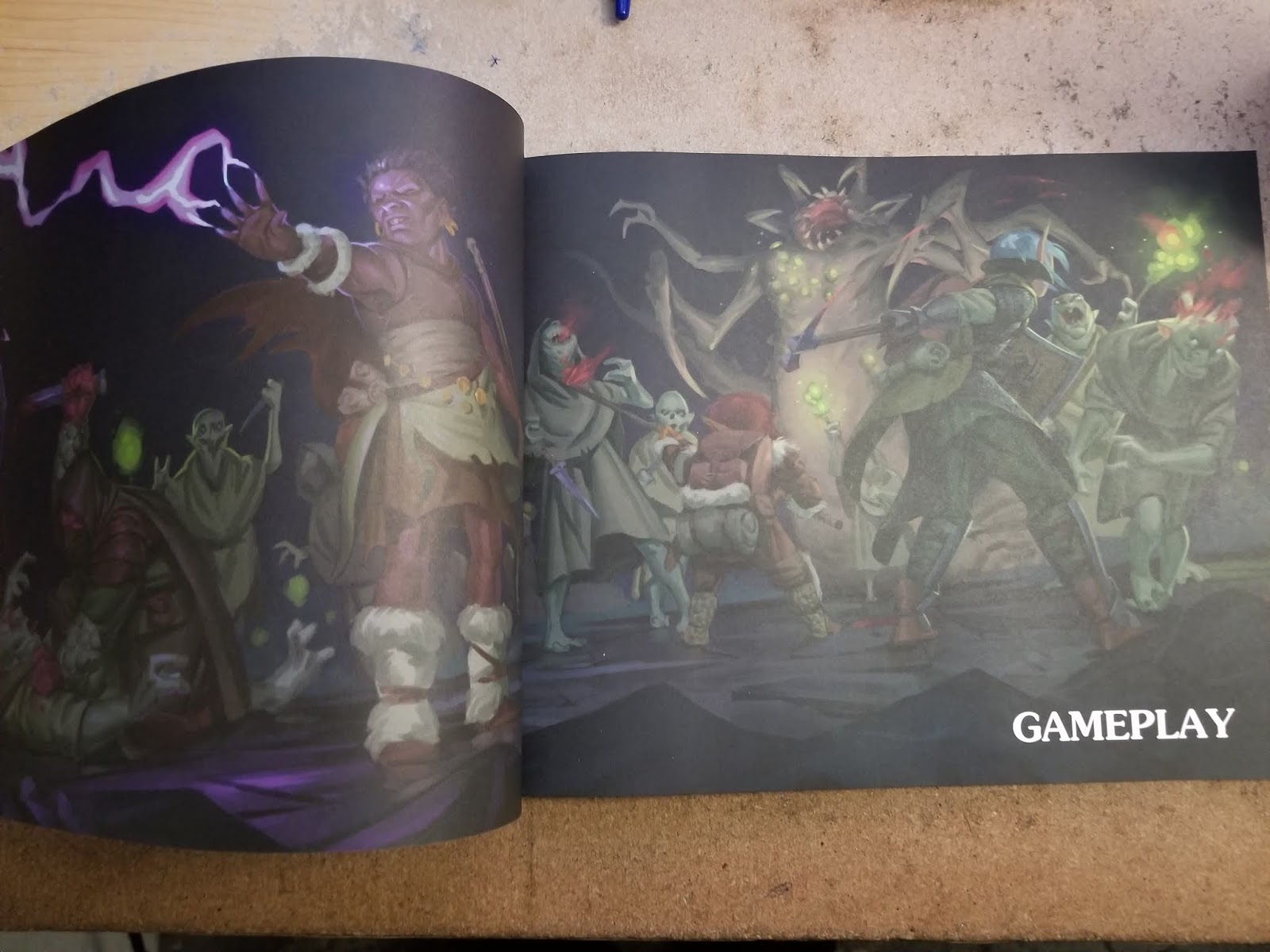
    Presentation: Five Torches deep presents in a clean three to two column layout that is adorned with color coded tables and full colored art. Some of the art is full page and spans across two pages. The physical book itself is an odd size as it is put together in a landscape format. The PDF is formatted just as nice and has multiple layout options but Five Torches Deep goes a step further with its digital formatting and officers an additional digital file that is specifically formatted for a smart phone or tablet (which is pretty awesome).


    Here is a screen shot from the mobile pdf taken with a smart phone:


    Character Creation: I found character creation to be really enjoyable and as you are creating your character you can really start to feel the OSR soul in this game. So, let us follow the bouncy ball...

    1. Pick Race (The options are Human, Dwarf, Elf, and Halfling)
    2. Roll Abilities (Each race has certain static abilities and certain abilities you roll 3d6 or 2d6+3. The interesting thing here is that class restriction is based on race and if that race ends up with the minimum attributes to enter desired class)
    3. Pick Class (The options are Warrior, Thief, Zealot, and Mage)
    4. Define or Pick Equipment
    5. Decide in Supple (SUP) carried
    6. Determine Total Load
    7. Pick Spells if Applicable
    8. Fill out your Character Sheet
    Resolution System: Even though the game has a 5e skeleton, it takes a lot of cues from the OSR movement in terms of simplicity and player agency. The core mechanic is 1d20 + modifiers compared against the actions Difficulty Class (DC). The game states pretty explicitly that the default DC for everything should be of DC of 11 (but may range between 5 and 20). The modifiers that can be added to the d20 roll is the characters proficiency bonus and their ability bonus (each modifier source is added once per roll). Combat is handled in the with the same type of roll but it is vs the targets AC and yes, the Five Torches Deep uses ascending armor. Some other resolution highlights include:
    • Skills have been reduced and simplified 
    • Proficiency bonus applies within stricter guidelines 
    • Magic system has been retooled and flattened with magical mishaps 
    • Advantage/Disadvantage
    • Slower and Weaker healing/rest
    • Equipment can be broken
    • Retainers, morale,, and reactions 
    The most innovative thing about Five Torches deep is its equipment rules and its encumbrance rules. Players can have a Supply rating and it allows the player to resupply the things they run out of like torches, arrows, etc. It cannot create new items but things the characters would carry in their backpacks. There are also rules of how characters can forage for SUP. All of this is blended in with equipment breaking and needed to be repaired really creates a focus on resource management and how prepared the party is when they go on their adventures.

    Another important highlight of the game is there is no dump stats. All stats are important and contribute to various aspects of the character.
    • STR: melee attacks and carry capacity
    • DEX: ranged attacks, initiative, and AC
    • CON: HP and how many hours you can stay awake/travel/fight
    • INT: some spells, and how much Supply you can carry.
    • WIS: some spells, and perception, morale
    • CHA: hirelings, number of magic items, social interaction

    Crunch: There really is not a lot of complicated rules or math. The math itself is semi compatible with B/X and 5e. Five Torches Deep has its own monster generator and other GM tools so I campaign can be played and ran with just this book. I think at first glance the Supply rules seem complicated but are actually simple in practice so new players have some issues implementing them effectively. I have spoken to author and he said veteran Five Torches Deep Players actually take zero to little SUP on adventures and just stock up on the gear they need (because SUP takes up encumbrance slots), which allows them to forage for SUP during the adventure as needed. 

    One of the more interesting areas where crunch was reduced was in the Races. The races are basically for flavor and aesthetics. They don't have any special abilities and what differences them is their class restrictions and how ability points are determined. I think this is really clever because it stops players from trying to pick the best class/race combo or choose race based on its special abilities. This also opens the door to easy race creation and the GM really does not have to worry about balance or any complicated math.

    Another section where the crunch was reduced is in class bloat. There are four classes but at certain levels the classes gain abilities and when they gain these abilities they pick from an archetype to progress in. You get abilities at levels 3 and 7 then at level 9 the proficiency bonus from your Archetype doubles. 
    • Warriors can progress as Fighters, Barbarians, and Rangers
    • The Thief can progress as Assassins, Rogues, or Bards
    • Zealots can progress as Clerics, Druids, or Paladins
    • Mages can progress as Sorcerers, Warlocks, or Wizards

    Final Thoughts: I have seen a lot of attempts to turn a lot of innovations from 5e into a rules light OSR style game. Some of the more rules light versions out there have done a really good job but Five Torches Deep has taken the middle ground and created something that captures the feel of the OSR with resource management and simple yet elegant resolution mechanics. I think people can really get a lot of miles out of this game and it does what it set out to do very well and very elegantly.

    Five Torches Deep does do something that I am not a fan of. In its design to push deadliness it ramped up weapon and monster damage while keeping HP/healing/recovery low. Basic Weapons are d6 (clubs and daggers) and all other weapons range from d8 to d12 where most of them falling into the d10/d12 range. If you do not want to roll for monster damage, they do an average of total hit dice +4. This triple threat approach would seem to end up as a death funnel for early levels.

    You can find Five Torches Deep on PDF and Print on Demand here.  The successful Kickstarter campaign can also be reviewed here.

    It also has a very clean character sheet and I tend to consider the quality of a games character sheet a big positive or negative.


    Friday, March 20, 2020

    Ode to Dave Arneson


    I know I posted about the first dungeon adventure on Dave Arneson Day and that post was inspired but a lot of talk about Dave and the documentary Secrets of Blackmoor that was being released about that time. This in turned spurned a lot of talk about how Dave Arneson and the twin city gamers played back in the day before we had all these crazy rule books that are thick enough to stop a bullet. The truth is, they adapted some rules from various war games and board games but a lot of it was very narrative based.  For an example of this, someone asked the Secrets of Blackmoor crew about how they handled various things such as hit points and below is the conversation;


    David Wesely who is the creator of Braunstein also commented in a recent online conversation about later editions of Dungeons and Dragons and their complexity;


    Dave Arneson created his own fantasy setting called Blackmoor. There have been a handful of Blackmoor campaign books that ranged from the original Dungeons and Dragons days to the 3.0 era. Some of the best information can be found online at The Blackmoor Archives. 


    Regardless of that quick history lesson, I was very inspired to create a game that would be in the spirit of Dave Arneson and I hope what I have came up with would be something he would be proud of. I decided to call it "Way of the Forgotten Hero". I named this because I view Dave Arneson has the forgotten hero of table top gaming.

    Character Creation

    1.Write down a name, be creative and clever.

    2.Choose a profession. A profession can be anything that is job focused and setting appropriate. Examples are Alchemist, Assassin, Barbarian, Beastmaster, Beggar, Blacksmith, Dancer, Executioner, Farmer, Gladiator, Hunter, Magician, Merchant, Mercenary, Midwife, Minstrel, Noble, Physician, Priest, Sailor, Scribe, Slave, Soldier, Temptress, Thief, and Worker.

    3.Write down three different words or phrases, called traits, about your character. Traits should be specific and not overly good. Traits can also include racial distinctions (elf, dwarf, etc.) and possible social affiliations.

    4. Write down any equipment you think your character should have with them or that would fit your character concept and 20 gold.

    5. Your character has 15 hit points.

    Tests

    When resolutions are not clear, the referee will call for a test. Players roll 1d12 vs. a Target Number determined by the referee (though this knowledge is usually kept from the players):

    Routine: 6+

    Challenging: 8+

    Heroic: 10+

    Legendary: 12+

    If any of your traits, profession*, or equipment can help then add +1 per trait, profession, or equipment that helps to the test. If any of your traits, professions, or equipment hinder the situation you suffer a penalty instead.

    *Professions cannot be used for direct combat.

    Opposed Tests

    Opposed tests happen when two sides are trying to achieve different goals but are in direct competition (ex. Arm wrestling). When this happens, both sides make a test a whichever side has the highest result wins. Some situations may require more then one test to accomplish the task.

    Combat

    The referee calls for initiative and everyone makes a test. The highest result goes first and everyone else follows in a clockwise order from whoever went first.

    Characters get two actions per turn. They can move and take one of the following:
    • Draw Weapon/Item
    • Use Magic 
    • Focus (+2 to next attack) 
    • Defend (+2 to Defense until the beginning of next turn) 
    • Attack (Melee or Ranged)
    All opponents that are considered a trained combatant (this includes the player characters) are considered to have a Defense of 6 and everything else has a Defense of 4. To make an attack, the player makes a test vs. the targets defense. If the attack is successful, damage is subtracted from the targets hit points.

    If miniatures are used, the player can move their miniature a normal pen length during their move action.

    Gear

    Some gear provides +1 to rolls. Weapons deal 1d6 points of damage. When two handed weapons are used, the player rolls 2d6 and chooses the highest. Light armor provides 1 point of damage reduction and heavy armor provides 2 points of damage reduction. Shields provide a +1 bonus to defense. Attacks and other damaging effects always deal 1 point of damage regardless of damage reduction from armor or other sources.

    Adversaries

    Most NPC’s and basic creatures possess 1-6 hit points and deal 1d6 damage. The more powerful the creature the more hit points they will have. Very rare abilities or creatures of unusual size can deal multiple d6’s of damage.

    Magic

    A character must have a trait related to magic to be able to use magic. Magic users can produce various minor effects, hinder an opponent for 1d6+1 rounds, and shoot bolts of energy that deal 1d6 damage. All uses of magic under duress require a test. On a result of 1, they magic user suffers burnout (cannot use magic) for 1d6 rounds. Each burnout result increased the range of burnout by 1 in the same day, after the 1st burnout result the range becomes 1-2, etc.

    Advancement

    After each session, the referee awards 1-3 experience points. When 10xp are accumulated they can be spent to gain 1d6 hit points OR an additional trait. If a trait is chosen, it should relate to the growth experienced during the story.


    The entire PDF of Way of the Forgotten Hero can be found here for free.