Showing posts with label FKR. Show all posts

Thursday, October 24, 2024

S&B Reforged Updates


So, as I teased earlier in this post I have been working on Sword & Backpack: Reforged and through lack of sleep and sheer stubbornness plus a healthy dose of inspiration the hack has been completed.  

I have even ordered a proof copy from Lulu but after doing so, I got it in my head that the blank note pages I included (to meet Lulu's minimum page requirement for global distribution) were not that professional so I am working on adding dot matrix pages instead, I have a friend of mine working on that as I type this. This means that I will need to order a new proof copy if I am able to work out the changes. I may just be paranoid and the blank pages titled Note may be just fine but that is the current situation for the print edition of Sword & Backpack: Reforged. 

With that being said, I have also made updates from the proposed version discussed earlier to the final version. These core updates are:

  • I have reduced math completely. There is now an advantage mechanic in place in specific situations. This will keep things simple and make interpreting the rolls faster.
  • Combat is now all or nothing. Whoever wins the roll off is allowed to deal a hit. This keeps combat fast, dynamic, and fixes action/turn economy in specific situations such as engaging a BBG. 
  • Adventurer hits have been increased. 

The final version across the board also includes:

  • 9 pieces of art
  • A sample adventuring party of 3
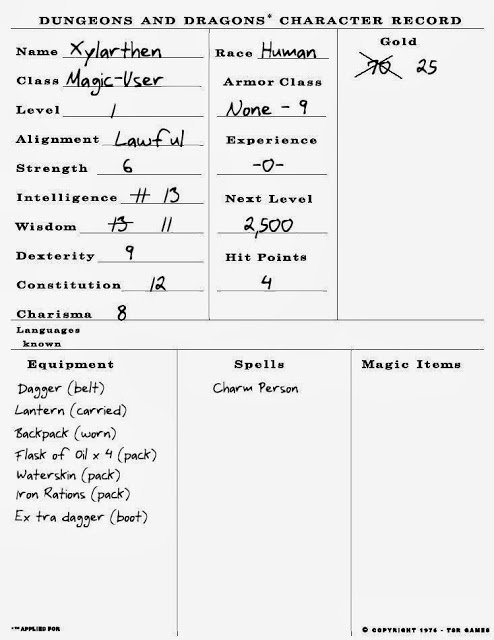
  • A character sheet

The PDF version will be 20-24 pages long that include note pages (US Letter) so it can be printed out in booklet style at home or at a print shop. If I do not include the cover art page, it will be 20. If I do include the cover art page it will be 24. 

The POD version is going to be 34 pages with 17 note or dot matrix pages that will be US Letter softback perfect bound.  

Finally, here is a sneak peak of the character sheet created by the talented Mr. Gone.


Thursday, September 26, 2024

Orthodox Sword & Backpack Part Deux


After extensive play testing and imminent release of Arsenic & Old Lace, the influences of Trollish Delver, Barrel Rider Games, Dungeon Crawl Classics, the 1937 "The Hobbit" as a setting, Crown and Skull, and of course Olde House Rules; I have done some serious tweaking on the "Secret Storyteller's Rulebook" for running Sword and Backpack that I initially discussed in my original Orthodox Sword & Backpack post.

As I was playing around with the bones, I wanted to accomplish a few things (not in any particular order):

  1. Honor the Legacy of the Twin City Gamers
  2. Reduce Math
  3. Honor the Original Material
  4. A "failed career" that has some impact because lets face it, no one is born an adventurer
  5. Smooth Combat


I think the FIRST thing is going to be create an example list of failed careers after the players choose their "job" and add the caveat of them writing down why the career failed and what was their call to adventure. Like one of the three jobs, they are considered to have the equipment from their failed career. I also think this enriches characters backstories and opens up role play options. Players can roll, choose, or work with the Storyteller of choosing something else. There may be some other examples as well.

  1. Alchemist
  2. Astrologer
  3. Barber
  4. Blacksmith
  5. Butcher
  6. Cutpurse
  7. Farmer
  8. Gambler
  9. Healer
  10. Hunter
  11. Mariner
  12. Mercenary
  13. Merchant
  14. Musician
  15. Rat Catcher
  16. Scribe
  17. Smuggler
  18. Soldier
  19. Trapper
  20. Vagrant

The SECOND thing is going to reduce math as much as possible. In my initial "secret rule book" I used a three tier difficulty to make choosing target numbers quick and characters got to add +5 to their roll if the action fell under the purview of their job. This is also the area where I want the "failed careers" to have an impact outside of lore and I want to keep the three tier difficulty base...so here we go...

  • If an action falls within the Job: 8+
  • In an action falls within the failed career: 10+
  • Everything else: 15+

The THIRD thing was to make combat player facing and it is something I spent a lot of time play-testing and I was truly on the fence about it. In the end, I decided to not handle combat this way. I wanted the experience to be more dynamic and engaging for everyone evolved. Plus, I think it would be fun to add a little bit of swing and chaos. For posterity sake I am going to include my original idea below.

  • If the characters tactics falls within the scope of their job OR the opponent/hazard is not meant to be strong: 8+
  • If it is standard opponent/hazard: 12+
  • All other opponents/hazards: 15+

Now, how I ended up to decide how to run it will be that there will be simple initiative (adventurers go first) and then the opponents. Everyone gets a turn and only the active adventurer or opponent as the ability to deal a hit (more on the below). Then the player and the Storyteller will both roll d20s and whoever has the highest result wins and the active adventurer or opponent will get to land a hit. Though, the caveat of this is that if the adventurer's job can be brought to bear then the players gets to add +5 to their roll!

Oh yes, I did it. I changed it up for combat. So sue me.


The FOURTH thing I was going to do was to hard wire in some resource management in the core so to speak but after much play-testing and introspection I decided against it. I am going to use a simple hit system like it has been done since the dawn of time. Adventurers start with 7 hits. Most opponents will have 1-2 hits and more powerful opponents will have more.  Simple as that.

So, putting this all together, it would look like this...

COMING SOON...


Saturday, April 20, 2024

SoA: Development Log 2


Writing has continued consistently since my initial Secrets of Arn and the first development log. I believe I have the character creation prompts locked down and I moved my focus to the Referee's "Secret Rule book." The secret rule book is basically how I would run games, what resolution processes to use, and what procedures to use to help keep the game going and to try to prevent the game from grinding to a halt. 

Even getting to this point was interesting because I went back and forth on how much should I include, how should I include it, or if I should just give some deep guidelines in running the game. I decided to use my secret rule book in its entirety so Referees have something to work with to make running the game easier. These Referee's can use it, change it, throw it out and write their own secret rule book, and do their own research. It is simply the tools I use but it is not law and might not even be the best way to handle things. It is simply what I do - nothing more and nothing less.

The heart of the decision and what all other decisions are going to be based off of is the dice, how they are used, and how they are interpreted. Though, due to the whole point of this project is to capture a certain style of play and to preserve history I need to take into account other aspects before making design decisions. Which, actually makes it easier in a way because a lot of how I would do things tends to align with history and the choice was simple. Use d6s!!!

The choice was made but the how presented difficulty and I ended up second guessing myself, third guessing myself, and spent some time wanting to chew my own neck off. After writing pros and cons list, having conversions with various people in the industry, I decided what was going to make the final decisions on how the dice work is going to come down to probabilities. 

Below is the classic 2d6 probability curve that let me explore options with different target numbers and opposed rolls. 

After some additional study, I ran the numbers with a 2d6/3d6 advantage mechanic. 

Now it is just a matter of deciding on the probabilities and I have to keep in mind that regardless how I set up it is going to work for the players the same as the referee. Looking at probabilities has helped me make some final decisions moving forward.

 Consistency and fairness is key because there is over 40 years of consistency!


I am going to end this with additional art by the talented Inked Gas...


Wednesday, April 10, 2024

FKR Simply Defined


In my initial "Definitions of FKR" post there is a lot of flowery language and great explanations of ideas which I think it is great. Though, re-reading it and after more experience it all sounds way to theoretical and may be confusing. I am going to list various aspects but they are not in any particular order.

The first thing is that playing games FKR style or FKR games are designed to be high trust or played with an high trust mindset. This roughly translates that the players trust the Referee to be fair, knowledgeable, and that the Referee is going to make clear consistent rulings. To condense this further, the Referee has a lot of authority to make unilateral decisions without necessarily failing back on any published rules. 


The second thing is that the Referee tracks a good amount of the player focus stuff. This could be magic points, hits, gear uses, and so on. By doing this, the referee creates an environment where the players spend more time immersed in the fiction.  

The third thing is that generally, the style is played with little rules. No 600 page rule books to be found as far as the eye can see. 

The forth and final thing tends to cause a lot of discussion and is something that causes a lot of confusion. FKR style games tend to be rules light and the players do not have access to whatever rules or ruling they are out going to experience during the course of play with the minor exception of what is needed for character creation (and to make meaningful decisions during that process). So, with that being said, it is possible to run Pathfinder, 5e, or even GURPS in an FKR style but I do not know why a Referee would want to do that to themselves. 

Here is where the confusion comes in. People will argue that Dave Arneson (and others) did not have rules when he ran his games but that is not the case. It is well documented that Arneson handed over 18 pages of rules to Gary Gygax that would be used to help design the original release of Dungeons & Dragons. Though, whatever rules or rulings Arneson used, he kept to himself and there was no players handbook that the players had access to. Hence, this is where the high trust aspect comes into play and the ye olde reference to the invisible rulebook.

Another point of contention that this forth aspect causes is that there is a lot of rules discussions regarding this style of game or play and it tends to frustrate the veterans and other people who have a lot of experience with this style of gaming. This has caused some of the veterans to step away from those conversations and those spaces. 

This situation just comes from a lack of understanding of the play style and a lack of comfort from people who have little or no experience of the play style because they want guidelines or sets of rulings to help them on their journey. That is where the barrage of rules questions come from. It also does not help that a lot of FKR products do not offer much in referee guidance outside of resolution mechanic and some character creation. There is no problem with people seeking rulings that they can use for their games or to use until they are comfortable to create their own. 

Circling back to the high trust aspect of FKR and the higher responsibility of the Referee I am going to try to smooth out the misunderstandings, wrinkles, and try to assist new Referees wanting to run games in this style. 

So, as a Referee for this style of game, you are in charge of creating a high trust environment, conducting research, and separating the players from the rules so they can be as immersed as possible in the experience. So, the referee should come to the table prepared with some baseline rulings, campaign information, and their handy dandy notebook. Depending on the comfort level of the referee will determine how much rulings they bring ready to go in their notebook and how much on the fly rulings they will make during the course of play. That is why it is important to have the notebook and to MAKE SURE TO WRITE IT DOWN so the Referee can make the exact same ruling or call the next time and the time after that. Consistency is key - hence the high trust aspect.

For an example, in a game that Arneson was running someone decided to throw a fireball and the response was what? The answer to the what was well, I am a wizard and that is what wizards do. So, on the spot the ruling for a fireball was decided and was written down in the notebook. 

As for research? Yes, it is important as the referee to take time to research things the characters in the game talk about, are interested in, or discuss. I am reminded of a story where Gary Gygax was running a game and there was a 16 year old high school kid at his table. During the session, the 16 year old announces that he hits the opponent with ??? (I do not know what the word is - but it was some fancy word for some fancy polearm) and Gygax had no idea what that was, but he did not let the 16 year old kid know that. So Gygax gave it a damage rating, wrote it down in the notebook, and then the next day Gygax went down to the library and read through a historical book on medieval weaponry. This is probably one of the reasons why there is a listing for every can opener on a stick in some of the books. Regardless, the point still stands. Referee's need to do their research and use their notebook to make sure their rulings and how they handle situations stay consistent.

That is the style of and how to run it on the referee side. The players responsibility in this is to trust the Referee and let go of all modern gaming sensibilities.

Wednesday, April 3, 2024

SoA: Development Log 1


One of the the first things I wanted to tackle with this project is decide how to handle character creation. From my research and conversations I have had character creation processes tended to be more free form that what is commonly seen today. This fact still held true even with the release of the Original Dungeons and Dragons. 

So, now I am left with two options. The first option is to go full free form character creation that includes the players answering questions and making some choices such as equipment and vocations. The second option is to still include the free from prompts but also add in some type of basic attribute stats to give the players and the Referee a numerical option to work off of. 

There was a long period of time where I was playing around with the second option but then I had a conversion with James Spahn and he brought up a point that made me stop in my tracks. Long story short is that the point of the conversation when looking at game design, take into account what is just habit. What ideas or sensibilities are you falling back on? That conversation reversed my thinking and I decided to focus on the first option. 

With the decision out of the way, now it is time to get to work on setting up the questions. The questions need to be personal, be descriptive enough (without becoming a tedious process) to bring a character to life, allow the player to see potential in the character's growth, name, choices for equipment/vocation, and bonds outside of the player characters. These choices need to make the player feel like the character is connected to the world. This connection will allow greater immersion. 

The most difficult part with the character creation is I need to make sure that the questions and number of the questions provide enough detail that new players are able visualize their characters and give them something solid to interact with the world without the process becoming a slog. As I have stated previously, I want Secrets of Arn to be easy to grasp for people who have never played this style of gaming before or even new gamers in general. 

My first couple rough drafts ping ponged back abs forth between 5-6 questions to 12-15 questions. During these drafts, I also went back and forth between allowing the players to choose a special ability for their characters or magic or both. In Bob Meyer's games he allows players to select special abilities for the purpose of uniqueness and to help keep magic out of the game because it does not matter what game, what idea, what system, magic tends to be a headache. 

After screaming endlessly into void, I decided the special ability character creation prompt is going to allow both options. So, a player can decide if they want their character to have a special ability or they want their character to be magically inclined. Special abilities are designed specifically for the character with the player and the Referee working together and can range from being exceptionally skilled at a certain task or aspect, turning the characters arms into tentacles, or even something that may be considered more magical or obscure in nature.

This decision is going to lead to more work down the road as I will have to figure out how magic is going to work and how I am going to limit it.

Though, figuring out magic is a future me problem. For now, I have finalized 8 prompts for the character creation process and I am happy how they turned out. At this point, I feel like the character creation process is done and the page could be handed out to get things rolling with little effort.


Sunday, March 24, 2024

Secrets of Arn


It is no secret that I prefer rules light games and the FKR style of play. I may not get chances play or run in those types of games often but my research into the history of the hobbit, how it affects what I want out of the table, how it effects my own Referee style, and how it effects my game design continues. 

The research and deep dive into history has also sent me into an archival mode so to speak. There are games, play styles, and history that has been lost to the sands of time or are close to it. This has created a drive to attempt to preserve things where I can. 

But I digress, last week I re-watched Secrets of Blackmoor and I came across this video about a week ago:

The above video was the tipping point that sent me into a creative spiral. I am harnessing this creative energy to create something that will capture the style of game Bob Meyer describes above, how Blackmoor was and continues to be played since 1975, and for an archival purposes as well. With all of that being said, here is what I want to accomplish with Secrets of Arn:

  • Players should only be given (will have access to) the character creation process
  • Character creation will be in a free form manner where the players answers various questions/prompts/and make choices 
  • Players will experience the rules as the play the game in an emergent and immersive way
  • Include the "secret" rule book for referees so anyone (even those that has never played this style of game before) has everything they need to share this experience with their players 
  • Straight forward rulings and "how to use dice" guidelines for the Referee to use as the story unfolds
  • Capture the DIY/Print it at home vibe

 It all seems like a lofty goal but I am hoping to create something that will stand the test of time, expose players and referees to a new gaming experience, and a game that the Twin City Gamer's would be proud of.  

The writing continues in earnest and I have received the cover art from Inked Gas! His art never fails to impress.  There will also be some art at the start of the Referee Guide and maybe some for the Referee Tools. There also may be some spot art included. 

Regardless, Enjoy the sneak peak at the cover!


Monday, October 16, 2023

Review: Mydwandr


Mydwandr is the most recent release by Olde House Rules and it sits firmly in the FKR realm with a dash for OSR/NSR for a little extra flavor. This build up to this release was pretty silent except for a handful of comments that something is in the works from the author. Then this game dropped and it took off - it did not take long to hit Copper on Drivethrurpg and it has already spurred some fan projects. This game came off of the heels of Gaming Primitive and the release of PP IV: The Divine Spark. So, lets take a deep dive and see what Mydwandr is all about. 

Presentation: Mydwandr clocks in at 60 pages of single spaced words that are cleanly laid out which captures the DIY feel of the 70's and 80's. The layout is supported by a full color cover, 14 full page black and white woodcut style images with some spot illustrations for support. The art and layout makes it feel like a manuscript from the Middle Ages.

Character Creation: Character creation follows a simple flow that provides some key choices. Though, I feel like it is important to post a quote from the book under the header "Characters" as it just provides foundational vibes for the rest of Mydwandr:

"Campaigns matter; but they need characters to occupy their spaces. These are the heroes of the story, and adventures, however enthralling, are just a thought experiment without the brave souls who undertake them. But character creation is likewise important to a campaign’s referee, who may be tasked with crafting their cast of non-player characters; for enemy humans remain the deadliest of all, even in a world of dragons, giants, and dark demons from the pits of Hell."
With that being said, character creation provides some important choices:

  1. Choose a Kindred (Dwarves, Elves, and Humans)
  2. Choose Abilities (Non-humans choose one while Humans choose two)
  3. Record Hit Points (Non-humans start with 10 while Humans start with 15)
  4. Note movement - Unarmored movement is 50' and armored movement is 30
  5. All characters start with a 100 Silver (SP) to buy gear and supplies


Resolution: When the dice need to hit the table for any reason, roll 2d6 and if the dice show 8+ it is considered a success (skills, saves, etc.). If an Ability or fictional situation provides advantage, the roll 3d6 and choose the two highest. 

Abilities come in two types: Common (CN) and Special (SL). Common (CN) Abilities provide extraordinary skill to things everyone can do which translates into Advantage using that Ability (for example: Footman, Mighty). Special (SL) abilities are unique abilities that require training to even attempt the skill. Special Abilities allow the attempt with throwing 2d6 (for example: Exorcist, Backstabber). 

Combat uses the core mechanic with a few nuances and it is important top note that all characters can wear armor and use any weapons. Before combat breaks out initiative is decided by both sides throwing doubles and whoever has the highest total goes first and the initiative is kept  the combat (ties favor the enemy unless fiction dictates differently and elves act on their own initiative due to their ability). There is advice where the Referee can forego initial initiative if one side or the other has a clever plan or ambush. 

Combat is divided in 30 second rounds where each participant gets to move and attack/cast a spell/etc. When it is a characters turn the player rolls doubles usually (unless advantage is acquired) and consult the totals for damage:

2-7: Miss/No Damage 

8-9: 1

10-11: 2

12: 3

Two handed weapons add +2 to damage but shield use is impossible and crossbows add +1 damage but takes a round to reload. 

When a character is reduced to 0 Hit Points, the character dies unless the character is wearing armor. Armor allows a death save and if it is successful, the character is revived to 5 Hit Points but the armor is broken and needs to be repaired or replaced. Carrying a shield provides an Armor Save as well. If a character has both armor and shield they can save verse death twice. 

Finally, Magic in Mydwandr takes on a free form approach.  Magic is covered by the Abilities Healer (heals a set amount of Hit Points per level per day) and Spellbinder (Enter the ye old Magic User - charms can be cast one per level per day. These charms can only be used against one target within 60' either scoring hits or manifesting a different effect with a duration of 3d6 rounds. Characters also cannot cast in armor or with shield as magic takes some serious movement). Outside of these parameters magic is free from and players create their own spells and effects. It is also important to note that magic is powerful and their is no "to hit" rolls or "saving dice" allowed - the charm just takes effect.

Final Thoughts: The reading of this book has more of a unique flow akin to a novel compared to the standard player handbooks that are out in the wild. In addition to the vibe of this book from cover to cover sets a tone of the type of game it wants to run from movement rules (Outdoor/Overland movement is 12 miles per day while underground movement is 500' per game play hour), how all characters can use weapons/wear armor, low focus on treasure and money, to how it is inspired by Hawk the SlayerChronicles of Prydain, Dragon Slayer and Ralph Bakshi's Lord of the Rings Animated Film

(Not in the Book but from Olde House Rules Social Media)

Other aspects of the game to give the game structure and assist the Referee are as follows (some of these reference the vibe or style of Mydwandr):

  • Money and Gear: Mydwandr provides a basic list of items that include weapons, armor, and basic traveling supplies. Prices for everything else are created by the referee with the guidelines of small/basic items cost a roll of a single die, medium items cost 2d6 x 10, large items cost 3d6 x 100, and extravagant items such as an entire ship could cost tens of thousands silver. 
  • Encumbrance: Characters can wear armor, carry a shield, bear a single favored weapon, and carry 25 items that can feasibly fit in a backpack or hang from a belt. 
  • Languages: Non-Humans speak their native language and the common tongue. 
  • Advancement: Experienced is gained from completing major quests, engaging hostilities, and recovering valuable treasure. More experience is given for the quests and valuable treasure the engaging with hostilities. Every 15 experience points gained, the character acquires a new level and will gain additional hits and abilities. 
  • Hazards: This is a section that lumps together monsters, NPC's, traps, ans environmental situations as "Hazards." Each of these hazards uses the same stat line so it is seamless for the Referee to run any hazard the characters come across. One of the numbers on the line is Level which when appropriate, translates as hit total as the Referee times the level by 1, 2, or 3 depending on how difficult the encounter is.
  • Darksight: Nothing that the PC's have access to have Darksight, not even Dwarves! 
  • Miniatures: Quick advice if the group wants to make use of miniatures - every inch squares 5' of movement. This removes the need for grids/hexes. 
  • Treasure: Formula for determining treasure based on treasure type in the stat line and chance for magical items. There are lists of magic item, 
  • Enchanting: Items are created by none player characters only and a PC that posses the required Abilities can write their own scrolls.
  • Towns/Wilderness/Dungeons: Advice, random encounters, and prices for services found in most towns are listed. 

Mydwandr also has approximately 8 pages of setting information regarding the lands, people, and history of Mydwandr. The entire game has a smooth flow and even though it reinforces a certain vibe for a campaign it is nowhere near locked into that idea. There is unlimited flexibility but enough structure to make the Referee's job easy and gives enough setting prompts that a Referee should be able to build off of that or drop adventure's inside the known world without much trouble. 

My favorite aspects of the game are how light sources are important as even Dwarves do not possess darksight, money is spent and acquired in low quantities (with XP only being awards for major treasure or artifact level discoveries), the take on elves, and how initiative is paramount in combat situations. 

With that being said, I wish there was more information or explanation regarding Balance as the paragraph under that section could be interpreted various ways such as all encounters need to be balanced but I do not think that is the intention of the design. I would have also liked to see a play example outside of the included combat example and the inclusion of 4-6 regenerated characters for a group to hit the ground running.

In all Honesty, I hope Olde House Rules rules writes an entire setting book for Mydwandr. Maybe it should be called the Chronicles of Mydwandr?

You cam find Olde House Rules and Mydwandr here:


Monday, October 9, 2023

Powered By Sword and Backpack


I have had this idea for a long time to attempt to create a Powered by Sword & Backpack movement. Something akin to a game jam that does not end. Since my previous post about my invisible rule book for Orthodox Sword & Backpack (some of the things in my invisible rule book has changed) and discovering that the game was removed off of itch but still exists in an old Tumblr blog has made me redouble my effort. This information made me paranoid that Sword & Backpack my vanish to the sands of time like TWERPS, Dinky Dungeons, and countless others. This is something I want to prevent as I think Sword & Backpack is an important touchstone to the table top role playing game scene. 


With that being said, this is more then just historical preservation and a call to arms because this is a CHALLENGE! As James George of Olde House Rules recently stated:

"I've always said crunchy systems are easy to write. It's the minimalist stuff that's challenging." 

I am already working on a hack that is lovingly titled "Arsenic & Old Lace" and I am hoping that it will be ready to be released into the wild sooner rather than later. Though, that is a minor note as a challenge needs rules. I know what you thinking but having some rules will create some uniformity and help keep the original spirit of Sword & Backpack alive. 

Without further ado, here they are:

1. How to Play and Storyteller section

2. At least three "Jobs"

3. Strong Implied Setting

4. Only a Single d20 for Resolution 

5. Invisible Rule Book 

6. Use of the Powered By Sword & Backpack Logo

7. Keep the Spirit of the Dungeonpunk Manifesto alive!

The Sword and Backpack logos were amazingly re-imagined by Luke Herbert (you can find him on IG @herbertappleseed). In addition, you can find the hi-resolution versions of all three styles here!


Friday, August 11, 2023

My Favorite Thing About the OSR/FKR/NSR


This post was actually funny to write because I realized what I wanted to talk about required some definitions and explaining. So, before I could even finish this post I had to talk about what FKR and the NSR were at their foundational ideals which spawned the above two posts.

Anyway, I know I have talked in length about how much (and why) I enjoy and prefer games that are rules light but the other night I was reading through Cairn and I realized what one of my favorite things about these games are. It is not the lightness of rules or the weird worlds or any other reason that I have gone on and on about. 

My #1 one favorite thing is that everything does not necessarily want to eat/kill/fight the characters. Even if the characters are in a dungeon or open up the wrong door in a tavern and find a table full of bugbears playing cards.

That is why I am a huge fan of reaction roles for initial disposition and allow the characters to role play the situation out. This creates for more immersive interactions and allows the players to help make real time decisions about the interactions. Speaking of players, they should already be aware that combat is usually not the only option and sometimes not even the wisest action. Gives great opportunity for parlay, teamwork, or even making some unique allies - even if it is just for a short time.


To take this idea and philosophy of not everything wants to immediately eat/fight/kill the characters a step further and to keep the immersion going is to remember that when the characters enter an area (especially in dungeons) the denizens of the dungeons should not just be standing around waiting to fight anything that walks through the archway. The original occupants should be doing something/anything - or moving around. I think this whole idea might need a post on its own one day.

Keep those reaction tables handle, roll liberally, and enjoy the interactions.


Wednesday, July 5, 2023

FKR & Beyond


I have probably mentioned FKR or Free Kriegsspiel Revolution on this blog a few times and how much I enjoy that style. If not, I have have had conversations at length about it in person, on Discord, and various other online platforms. It is also the style of gaming that birthed the gaming we have now from the tables and basements of the Twin City Gamers. I cannot recommend enough watching Secrets of Blackmoor.

Though, thinking about I know I may not always explain what it is at all or well and I am firm believer in the definition of terms. So, I am going to try to define it with a couple of points below: 

  1. FKR tends to be rules light but not completely free form. I think that is an important distinction. It is common for resolution to use opposed 2d6 or 2d6 verse a target number. Though there are various other dice tasks used as well. FKR games tend to use mechanics as a servant of the players and the referee and the game is not submissive to them in anyway shape or form. The rules also evolve in a table centric way.
  2. FKR games also as a point of practice, attempts to eschew most rules in favor of realism and immersion.   This allows the players to get lost in the fiction and just describe what their character does and leaves it up to the referee to make any adjustments or rulings as needed. This lack of rules allows characters to do more.
  3. FKR has a focus on invisible rulesbooks are visible ones. A lot of the people that played with Dave Arneson have talked about how they never saw any type off rule book except the notes they had on their character sheet. Though, Dave did have a rule book, and between the scribbled notes the rule book was invisible.
  4. FKR is a HIGH-TRUST-GAME. It is only going to be successful if all of the players trust the Referee to make fair, just, and consistent rulings. There are no rules where the Referee is caged under or shackled to. 
  5. FKR can, at times, emulate some board games or older war games where manipulating vague rules to the characters advantage is part of the fun. This brings the focus to worlds not rules. 
  6. Finally, FKR shows the joy of tactical infinity and the players using real world problem solving skills to solve the actual problems.
Now, with all that being said, it is important to note that the rulings, we well - important. As without them the game becomes group fiction. 
 

I would be remiss if I did not re-post the Free Kriegsspiel Revolution that currently only exists as a screenshot on a Discord pin and was original penned by Wizard Lizard.