Sunday, July 5, 2020

Review: Supercalla


Disclaimer: A PDF of this was provided to me for review purposes. 

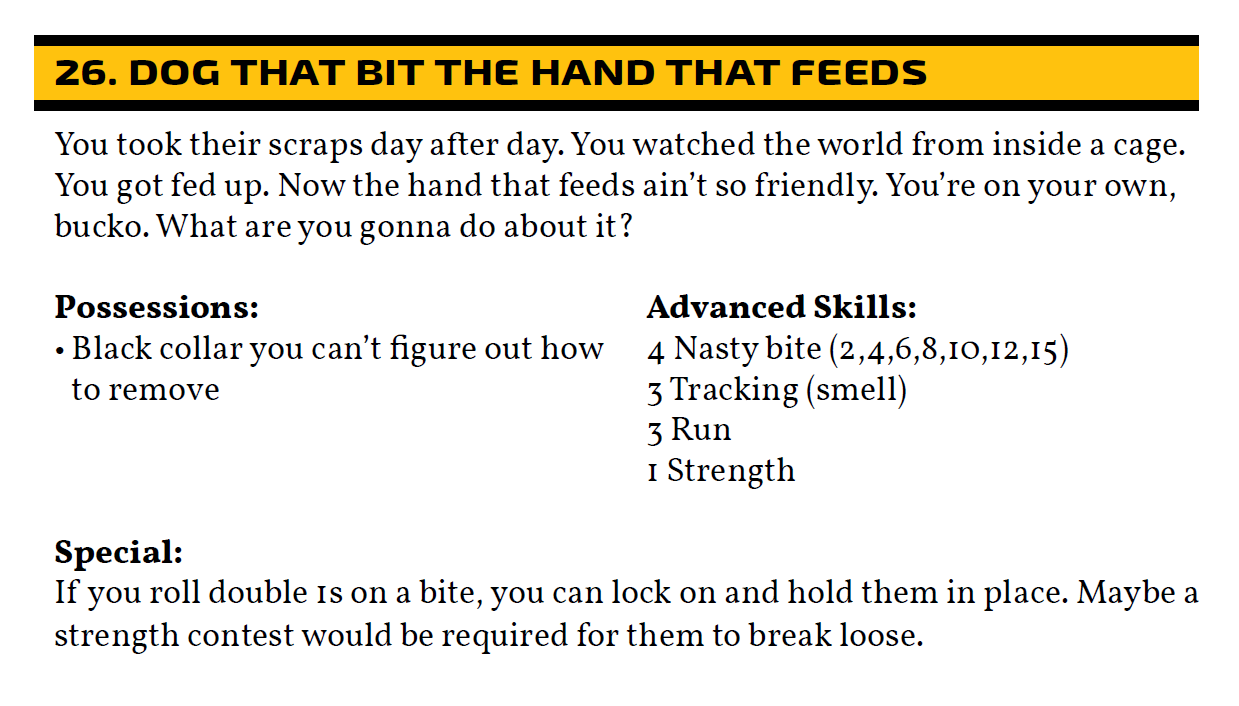
Supercalla is a supplement for Troika! by Random Order Creations (you can find my review of it here). It provides 37 new backgrounds for Troika! with a baked in and implied setting. It also includes character creation rules and other tweaks to the core mechanics found in Troika!.

What is the setting you ask? It is if Judge Dredd, Mad Max, and Blade Runner had a lovechild and that child was named Supercalla! Each page and the descriptions of the backgrounds are all very evocative and reinforce this implied setting. 


Presentation: Supercalla is 50 pages of single column full color art and formatting that really captures the feel of an highway to hell. It also includes a great custom character sheet. It is well organized with a table of contents, character background table, and various other GM friendly tables to help out in various situations. It is written and illustrated by James V. West and his art style is just fantastic and really captures the feel of Supercalla. The setting just drips out of the images and the formatting. 


Character Creation: The character creation in Supercall slightly deviants from the one found in Troika!
  1.  Determine Skill Stat: 1d3+3
  2. Determine Stamina Stat: 2d6+12
  3. Determine Luck: 1d6+6
  4. There are certain possessions the characters start with if they are not a robot or droid and there are certain possesses robots and droids start with
  5. Roll d66 to determine background
This section also states a rule I really like - the whiff rule! It states that if you roll less then 5 you can sacrifice two levels of advanced skills to bring it up to 5.


Resolution and Crunch: My thoughts and breakdown on Troika! and its system can be found in my review if it here.

Final Thoughts: This is really impressive all the way around. All of the art and the backgrounds are full of flavor and reinforce the implied setting - you could even run a post apocalyptic Deadlands style game as well. James V. West style of art really reminds me of Bill Willingham and Vaughn Bode which is a good thing. 

There is so much potential for campaigns, one shots, and just idea mining found in these 50 pages that makes it so impressive. 

With that being said, I wish there was more setting information that was actually written out and more art. 

You can find Supercalla on drivethrurpg in pdf and print on demand.

Always remember that regardless of where your iron horse takes you, follow the rules of the Highway!

Thursday, July 2, 2020

Detroit Suck City: Episode 5


As some of the crew laughed nervously at Auron's comment to Huey they were all very cautious as they have no idea what could be lurking ahead. The crew discussed various tactics before moving forward into the the long underpass but in the end Wilhem decided to turn invisible and carry a torch to lead the way (the effectively made Wilhelm a disembodied floating ball of fire...). 

The first underpass and no shortage of heads on spikes (mostly Masters of Clean and mutated animals) they crew was able to get to the other side without incident. As the crew passed under the second overpass three large spiders dropped down form the ceiling with one dropping right into the Velotank! Wilhelm fought one with his torch and burning in multiple times (the eight legged freak was really confused with the floating fire) before it finally succumbed to its burns. As this was going on chaos ensued inside the tank as Lladmar and Jiminy where engaged in melee with a flailing and biting spider - they were trying to beat it into a pulp before they got crushed or became spider food. During the melee in the tank Parrot ended up tackling and wrestling with the third spider that was trying to join the fray inside of the tank and they ended up wrestling under the tank...

After what seemed like a never ending whirlwind of spider legs, the clang of metal, and battle cries the crew emerged victorious. As Lladmar and Jiminy web and guts covered were dragging the body of the spider out of the tank with disconnected legs, Parrot rolled crawled out from underneath the tank spitting out a chunk of spider and dusting the dirt off of his pants. Lladmar, Jiminy, and Parrot all gave each other a look that simultaneously asked, "What the hell happened to you?" and answered, "I don't want to talk about it.". They all jumped as they heard someone approaching but it was just Wilhelm carrying a broken torch that had crispy spider bits attached to it. Upon further inspection of the spiders (or what was left of them) the crew realized that they had white star burst pattern on them which meant someone was probably controlling them or they were trained.


The crew decided they needed to clear these underpasses as soon as possible and upon doing so found some tracks that vanished into the overgrown brush that branched off of the tracks they were currently on. Wilhelm was able to figure out how to switch the tracks over and they hid the Velotank in the underbrush to catch up on some sleep and regroup. They took turns taking watch and on Jiminy's watch he noticed the smell of burning fuel and loud mechanical sounds. The smell and sounds got stronger as the tracks started to vibrate when some loud machine passed the crew's hiding spot and did not notice them. 


In the morning hours as the crew started to stir they noticed bright yellow well kept vehicle (something that looked like a 1971 Ford Mustang) flying erratically around in the sky above them as the four dark figures with horribly disfigured faces appeared to be drinking and singing a long to some really strange noise. The riders did not notice the crew until Jiminy jumped up in the turret of the 50 cal and fired some rounds in the yellow cars direction. The riders then proceeded to sly more erratically as they started to throw smoke bombs in the direction of the 50 cal fire. Luckily for them Jiminy was a horrible shot and they appeared to be enjoying the game of cat and mouse until some stray bullets put holes in the riders shiny yellow car. This really pissed the riders off and they drunkenly threw a Tor grenade at the crew which missed its mark by a wide margin but when it exploded it sonically vaporized everything in a 30 meter diameter. 


This explosion left the crew exposed, knocked Jiminy 20 meters back and buried him under some trees, rocked the Velotank, deafened/stunned the rest of the crew, and the sonic boom of the blast echoed throughout the valley. 

The crew stumbles around dazed and deaf trying to dig Jiminy out of the trees as they regroup under the sky the color of sun dried yellow dog puke.

It is just another day in Detroit Suck City...

*Disclaimer: The players of Auron and Huey were unable to attend this episode. 

Sunday, June 28, 2020

Review: Tiny Supers


"Four or five moments - that's all it takes to become a hero. Everyone thinks it's a full-time job. Wake up a hero. Brush your teeth a hero. Go to work a hero. Not true. Over a lifetime there are only four or five moments that really matter. Moments when you're offered a choice to make a sacrifice, conquer a flaw, save a friend - spare an enemy. In these moments everything else falls away..."

I have enjoyed my various experiences with the Tiny D6 system from Gallant Knight Games and when I saw they were doing a kickstarter for Tiny Supers I was really excited and I followed along all of the hype it got (and I really hope it holds up to the hype). I was unable to participate in the kickstarter but Gallant Knight Games recently provided me with a PDF for this review but I did pick up the physical book and I will be using the physical book for this review.


Presentation: The book itself is full color hardback in an A5 format with single column pages. It is well organized with a table of contents and easy to read yet setting appropriate fonts. What really stands out to me is the art. It feel like it goes beyond capturing the feel of the super hero genre because it creates a mood if super heroes were real in our modern times. The art style is a mix of something you would find in a class four color comic book and more modern cartoon styles.One of my favorite things about the organization of this book (and all Tiny books for that matter) is the resolution rules are in the front of the book before you get into anything else.

Character Creation: This process is straight forward and gives you different power level options to choose for your desired campaign level.
  1. Select an Archetype: These include Paragon, Defenders, Striker, Gadgeteer, Expert, Controller, and Mastermind. These provide an overall style of hero and decide the characters starting stress in addition to providing a trait. 
  2. Power Traits: Select three power traits from the list a normal trait can be substituted for a power trait. The power options are Armored, Blast, Elemental Control, Energy Control, Flight, Force Field, Gravitics, Healing, Immunity, Invisibility, Mind Reading, Phasing, Regeneration, Shapeshifting, Snare, Summoning, Super Movement, Super Senses, Super Speed, Super Strength, Telekinesis, and Teleport. The normal traits are Acrobat, Alchemist, Armor Master, Barfighter, Beastspeaker, Berserker, Brawler, Charismatic, Cleave, Dark-Fighter, Detective, Diehard, Educated, Eidetic Memory, Familiar. Fleet of Foot, Healer, Insightful, Lucky, Marksman, Martial Artist, Nimble Fingers, Opportunist, Perceptive, Quick Shot, Resolute, Shield Breaker, Sneaky, Spell-Reader, Spell Touched, Strong, Survivalist, Tough, Tracker, Trapmaster, Vigilant, and Wealthy. 
  3. Select a Power Origin: This is basically where does the characters powers come from. Some of the suggestions given are Alien, Dimensional, Enhanced (Super Soldier), Inventor, Magical, Mutant, and Technological (Cyborg, etc.).
  4. Weakness: Each character must have a weakness. The players work with the GM to come up with something. I really like how open ended this is. 
  5. Select a Weapon Group to be Proficient With: The categories are Light Melee, Heavy Melee, and Ranged. 
  6. Select Belief: This can be anything that your character deeply believes in. It should be a sentence or two long and will help bring the character to life. 
The power options outside of the standard character creation process are street level (where everyone can only start with one power trait and the other two traits must be normal traits), Super Team! (where everyone starts with 5 power traits that can be substituted for normal traits), or cosmic (where everyone starts with 8 power traits and these can be substitute for normal traits).

Resolution: This resolves around making tests the require a 2d6 roll and the test is successful if any of the dice come up a 5 or 6. Some powers, traits, and gaming fiction can give the player advantage to the roll which means 3d6 are rolled. Certain situations can also lead to disadvantage on the roll which means 1d6 is rolled. In a situation where advantage and disadvantage happens at the same the disadvantage mechanics prevail unless magic or some type of super science is involved (then the advantage mechanics win because Super Heroes!). Tests can be considered normal tests, an obstacle test, or a save test. The resolution is the same but the story that triggers the test is different.


Crunch: With a title like Tiny Supers the crunch is light and I will split it into super powers, traits, combat, advancement, and everything else. 
  • Super Powers: Each of the listed powers gave three tiers. It costs one point trait point for each tier. The tiers either build off of each other or makes the base power more effective. The list of powers covers all of the bases and it is explained and reinforced that the player can decide how these powers manifest. So, for example if a character has Armored they could just be really tough, have scales, their body could be made out of metal, or it could even be described as luck. This type of agency exists for all powers which really opens the options and gives each character the ability to be unique even they have the same power. 
  • Traits: These give the character some type of boon such as advantage in certain situations, a new skill set, or even some background ability such as being Wealthy. They are bought on a 1 for 1 system and have no tiers. Traits also have a movie quote attached to he description which gives them a lot of flavor and for those familiar with other Tiny d6 games, a lot of these traits can be found in the other games.
  • Combat: Combat is broken down to the following steps:
  1.  Initiative: Each participant rolls 2d6 and adds them together. The turn order becomes highest to lowest. If there is a tie between an enemy and a super the super always goes first. If there is a tie between supers, the players re-roll until the tie is broken to see who goes first on the original initiative. 
  2. Actions: Each character has two two actions during their initiative turn. These are usually made up of being able to move and attack. Though a character can move twice or attack twice. There are also two special actions the character can do. The first one is Focus that changes the success rate for the next attack to 4, 5, or 6 (the focus action remains in effect until the character attacks or the combat ends). The second special action is Evade which allows allows the character to passively dodge incoming attacks. Until the beginning of your next turn, you can test 1d6 when successfully hit by an enemy - if the test is successful the attack is dodged. 
  3. Resolving Damage: Each successful attack deals a 1 point of stress unless modified by a power or trait, story circumstances, or if the character is using a heavy weapon (which deals a base of 2 stress).  
  4. Death: If a character reaches zero stress they are knocked unconscious and get two chances to make a test to stabilize (each time their initiative comes up) - if they are successful they stabilize ans gain 1 Stress. If they fail, if another character cannot help them, of if they are attacked again while unconscious the character dies.
  5. Option Rule - Range Bands: There is an optional rule that includes the use of range bands which are (and the actions that can be taken to and for each range band) Close (Light Melee, Heavy Melee, Magic), Near (Heavy Melee, Ranged, Magic), and Far (Ranged, Magic). Close roughly translates as within 5ft, Near roughly translates as 10-15ft, and Far is everything else. During combat the enemies remain stationary and the heroes move around them most of the time. It takes a move action to shift between each range band. 
  • Experience/Advancement: Tiny Supers provides two different options for advancement. The first advancement is the minimalist advancement and characters gain a new trait every 3 sessions but cannot have more then 7 traits. If a trait would be gained after a character has the maximum of 7, the player can switch out a non archetype trait for new one. The second advancement track is where the GM passes out about 1-4 experience points a session ans these experience points be spent to permanently increase the characters Stress Capacity by 1 (6xp), a new proficient or mastered weapon (8xp), or a new trait (10xp).
  • Everything Else: Well, all other actions that could trigger a test are resolved by role playing and said role playing could cause advantage or disadvantage (or some traits may cause advantage). 

Final Thoughts: When all is said is done we have a supers RPG that clocks in at a total page count of 260. 4 pages for introduction and legal stuff, 14 pages for core rules, 23 pages for super creation, 169 pages about the Gallantverse (the included setting), 44 pages of micro settings, and a page for the character sheet. 

I find that minimalist/rules light gaming finds one of its best fit in the supers genre. Anyone who has spent any time watching super movies or reading comics sees how creative the heroes can be in using their powers and solving various problems. Tiny d6 really allows for great player agency so they can be as creative or loony as possible (as the flavor of the campaign allows). 

Tiny Supers with its large built it setting or its 8 micro settings provide a lot of fluff to get any campaign going and they all can be mined for all kinds of home brew shenanigans. This game provides a group with everything they need to run a epic campaign or can allow easy one shots/short campaigns. 

The micro settings are one of the my favorite aspects about Tiny Supers (and the tiny games in general) but what really stands out is how the powers are tiered. This allows variation (on top of how the players can decide how the power works/looks/feels like) for characters that have the same powers. I also really like how the game built in balance so characters that are built to be hard to damage/indestructible can be damaged. This is done by the Powerful Blows Trait that only strikers have which states that the damage they deal cannot be reduced. This includes the use of the Armored power.

Where I think the powers section falls short is that there are no rules for disadvantage aspects of powers. Outside of fluff there are no mechanics to support characters or needs to transform to access their powers, need to suit up, or require various items. These are a common trope and can be a large disadvantage. Tiny Supers being rules light, this is easy to rectify by saying any power with these types of drawbacks give the player an additional trait point to use. Regardless of this, I think it is something that should have been included. 

Another common trope that is missing is any type of system support for hide outs or super vehicles outside of the gadgeteer power trait. Once again, this can be easily hand waved and is something that can play a minor role but due to the commonality of the trope, I feel like it should have been included as well. 


Tiny Supers can be found:
Additional Supplements and Support are:

Friday, June 26, 2020

Chainmail Bikinis and Loincloths


After my my last post where I talked about armor and the different rules for it I got asked the question about chainmail bikinis and loincloths. I almost went back and edited that post to include it but then I figured this topic needed a post of its own. 

The idea of a chainmail bikini, loin cloth, battle armor, bracers, and maybe a shirt as armor is laughable in a realistic sense but who cares? It is all about style and setting. The genre of Sword and Sorcery is full of heroes that do not wear armor beyond some regular clothes or a random piece of armor here and there. Then we have the icon Conan and Red Sonja style heroes.

So, using the ideas discussed from my Make Mithril Great Again post lets see what I can do.

  • Ascending Armor:  AC is calculated by Dex Modifier + Charisma Modifier. Chainmail undies provide a +2 AC bonus. If any armor worn is heavier then chainmail undies then the character loses the benefits from the Charisma Modifier to AC. Shields can still be used.
  • Ascending Armor w/ Damage Reduction: Chainmail undies provide the following benefits: AC Bonus +1(11) + Dex, DR 1. In addition, Charisma modifiers are added to the DR. If any armor worn is heavier then chainmail undies then the character loses the benefits from the Charisma Modifier to DR. Shields can still be used.

  • Descending Armor:  Requires a Charisma of 15+ and a Constitution of 15+. AC is 4. Shields can still be used. 
  • 2nd Wind: If the character states that they are wearing the appropriate garb then they have the benefits of armor. 
  • Armor Pool of HP/Wounds: Treat it as light armor and if the game has a mechanic for Charisma (or something like it) then give the armor a bonus. 
  • Armor that Completely Ignores Hits: Treat it as light armor and if the game has a mechanic for Charisma (or something like it) then give the armor a bonus. 
  • Armor Saves: Treat it as light armor and if the game has a mechanic for Charisma (or something like it) then give the armor a bonus. 
Then, a final point I would like to make is the character choosing this style is considered clothed for elements. Once again, it is all about style and theme.

Thursday, June 25, 2020

Detroit Suck City: Episode 4


As the crew recovers from their latest adventures on the tracks as some of them are still picking crab meat out of their hair they notice a naked male that is covered in gore standing out away from the tracks just staying at the crew. This naked guy has a symbol of the Masters of Clean tattooed on his chest. It is decided by the crew that Wilhelm will make contact as he is human looking and during the contact the naked male appears confused and does not know how he got to where he is. After some talking and time the naked male introduces himself as Huey and acts very put off by being surrounded by mutants. It is decided that Huey is alright and can come along. The crew then help Huey forage for some clothes and gear from the various piles of dead bodies.

The crew cautiously works their way farther down the tracks and they come across an odd yellow heavily armored train car that has the letters T O Y O T A on the side. This rail vehicle has a large gun on the top and looks like it was meant to be some type of tank. Wilhelm and the rest of the crew crawl inside and Wilhelm is able to figure out how it works. There is a two sided hand crank in the middle and with a little muscle power it should be able to move. After Wilhelm explains how it "drives" to everyone else Wilhelm climbs to the top of the tank and works on figuring out how the gun works. It does not take Wilhelm long before unleashing a burst of automatic fire that gives everyone a good scare and sends the crew into battle positions. 


Before the crew leaves the area in their newly acquired Velotank they decide to explore the very last train car in this section of the tracks. Lladmar stands guard as Huey enters the car to investigate (the rest of the crew remains close to the Velotank on high alert). As Huey enters the train car he finds another pile of dead bodies and as Huey take a closer look he is ambushed as he feels something wrap around his waist and teeth dig into his shoulder. Lladmar hears Huey's yelp of pain and decides do jam is assault rifle into one of the holes of the train car and open fire. Luckily Lladmar's bullets do not hit Huey but also appear to miss or be un-effective against whatever is trying to eat Huey.

As the rest of the crew notices the chaos Huey appears outside of the car and then Wilhelm yells to everyone to get down as he unleashes the power of the tanks gun into the rail car. The bullets quickly turn said rail car into Swiss cheese. As the dust settles the crew notices two very large snake like creatures flying off into the trees. Whatever they were, they did not like the situation they found themselves in and decides to retreat. 


The crew loads up in the tank and travels down the tracks and as the afternoon wears on the crew decides to take a break and deal with with their injuries as they take log of their gear. During this "relaxed" time Huey shares that his people and the Black Star children have been at war for sometime and he was actually a victim of their experiments just like Wilhelm - that might explain the giant eye on the back of Huey's head and his ability to teleport or so it seems.

After this rest, the crew moves farther down the tracks towards the industrial complex on the horizon with Auron and Lladmar at the crank, Wilhelm and Huey on lookout with Wilhelm using his binoculars to scan on ahead. Up ahead Wilhelm notices a group of carcasses and orders them stop as the crew gets closer.

Upon stopping it is evident that these carcasses are Po Dogs and they have been slaughtered for the sake of being killed - these Po Dogs appear to be torn apart. Blood and signs of struggle are everywhere in addition to oddly burnt surrounding vegetation. Auron, Wilhelm, and Lladmar exit the and investigate the scene further. During that time, Wilhelm notices some movement and hears mewling sound. Wilhelm quickly hands off his weapon to Auron and under one of the carcasses he finds a surviing Po Dog pup, cradles it to his chest, and starts walking back to the tank. Once everyone is inside and the crew is moving again Wilhelm explains how he used to raise Po Dogs and that he is going to take care of this one. No one in the crew objects as they roll closer to the industrial complex.

Once the crew enters the complex they remain on high alert scanning for any signs of an ambush or other forms of hostility. Everyone agrees it is not wise to stop here and as the tank passes under the cement underpass on the far side of the complex they notice countless spikes with heads adorning each on. Each of these heads appears to be bald with gold ear rings and Auron looks over to Huey and states, "I think we found your friends...".


It is just another day in Detroit Suck City...

*Disclaimer: The player playing Jiminy was unable to attend this episode. 

Friday, May 15, 2020

Bunnies and Burrows: Risus Edition


Bunnies and Burrows was a game that came out in the 80's from Fantasy Flight Games and was actually revolutionary for its time. It was one of the first games to have a skill system. Anyway, I did a conversion of it using Risus awhile back and I figured I would share.

Character Creation

Standard Character Creation: 10 dice per core rules

Special Character Creation Bonus: Due to the very fortunate nature of rabbits, they all begin play with three Lucky Shots at no cost.

New Clichés:

  • Warren Watch (being big and tough, protecting the Warren)
  • Hoplite (being Swift, scouting ahead)
  • Engineer (inventing simple contraptions, understanding human machinery)
  • Seer* (using ESP, having scary dreams)
  • Empathetic Healer* (healing other rabbits wounds)
  • Herbalist* (identifying plants, preparing snuffballs)
  • Storyteller* (telling entertaining tales, enthralling whoever is listening)
  • Bun Fu Martial Artist* (doing cool moves, beating up enemies)
  • Maverick (living alone, wondering around)
  • Bunny King (ruling all other rabbits, eating a lot of food)
  • General (head of the Efrafa, militant, strong)
  • Captain ( answers only to the General of the Efrafa, brave, loyal)
  • Rabbit (being fast, skittish, and generally rabbit like)
* Can be Double Bumped


Encounters

Wondering Encounters: The wilderness is a scary place and other animals besides rabbits occupy it. When a rabbit(s) is outside, above ground, and unhidden wondering encounters are more frequent and could possibly be encounters with predators. When a rabbit(s) is concealed and above ground encounters happen less frequent and when the rabbit(s) are safely tucked in their burrows at night wondering encounters are very rare. The GM makes the roll in secret and the implements the effects in game. (This is a GM tool and can be used as needed). This is accomplished in the following order;

Occupant Encounters As rabbits explore the world they come across traps, manmade structures, and other environmental features. As rabbits go exploring the GM can make a roll on the following table to cause a random environmental encounter of some kind (again, this is an optional GM tool). The GM rolls secretly the following table;

The Predatory Critters All predatory critters should have something along these stat lines.

Random Predator

- Random Predator Name [1-6]

- Secondary Cliché [1-4] (Optional)

- Third Cliché [1-3] (Optional)


Random Predator Swarms/Packs

- Random Predator Swarms/Pack Name [1-12]

- Secondary Cliché [1-6] (Optional)

- Third Cliché [1-4] (Optional)

Examples of Predators: Wild Dogs, Fox, Coyote, Dog, Wolf, House Cat, Bobcat, Cougar, Weasel, Ferret, Badger, Wolverine, Black Bear, Grizzly Bear, Mongoose, Flying Wolves, Crow, Raven, Falcon, Harrier, Rough-Legged Hawk, Red-Tailed Hawk, Burrowing Owl, Great Horned Howl, Eagle, Rattlesnake, Cottonmouth, Snapping Turtle, Scorpion, Tarantula, Black Widow, Water Spider, and Wasp Nest.


The Neutral Critters: The Neutral Critters follow the same rules as Predatory creatures except these creatures are not going to try to automatically harm the rabbits.
Examples of Neutral Animals: Vulture, Pheasant, Pigeon, Robin, Sparrow, Killdeer, Blackbird, Squirrel, Cow, Horse, Jackrabbit, Marmot, Armadillo, Mole, Garter Snake, Hog-Noses Snake, Tortoise, Lizard, Grasshopper, Beetle, Butterfly, Ant Nest, Dragonfly, Earthworm, Blue Jay, Grouse, Starling, Deer Mouse, Quail, Pack Rat, Porcupine, Opossum, Raccoon, Skunk, Salamander, Cicada, Moth/Caterpillar, Termite Nest, Honey Bee, Earthworm, Wild Pig, Centipede, Spider, Cockroach, Goose, Sea Gull, Heron, Duck, Beaver, Bull Frog, and Elk.

The Humans: Humans are usually big and scary and rabbits really do not understand them. Human stats should be tailored around the following example;

Farmer John

This human owns a lot of land and farms produce as well as own cows as well as chickens. He carries around a gun for foxes and other predators but has a soft spot for the rabbits as long as they stay out of the miss’s garden.

- Human [1-6]

- Old Quirky Farmer [1-5]

- Rusty Tractor Maker/Fixer [1-4]

Advanced Options

With these options in play, players can spend their character creation on something other than Clichés. Players can receive 3 Lucky Dice or 5 Questing Dice per 1 die of character creation die spent. Due to the lucky nature of rabbits, only one character creation dice can be spent on Lucky Shots, for a Maximum of 6.

Lucky Shot: Using a Lucky Shot boosts one of your Clichés by one die per Lucky Shot used. This can give you just the amount of edge or the “luck” on an important roll. Your Lucky Shots recharge between game sessions but cannot be hoarded.

Questing Dice: Questing Dice are Lucky Shots with a focus. They are less flexible because they are tired to a character personal quest, a specific mission, a burning passion or hatred, and a love that defines them. Characters that are not on a specific quest should not be allowed to use questing dice and cannot be used for something broad. They can only be used to boost in anything standing in the way to the characters personal quest.

With Hooks and Tales in play, the player can bargain with the GM for extra character creation dice after giving his character a Hook and/or a Tale.

Hooks: A hook is some significant character flaw - an obsession, a weakness, a sworn vow, a permanent crippling injury - that the GM finds so juicy and will use it to make the characters life more interesting or more difficult. This is worth one extra die.

Tales: A “tale” is a written biography describing his/her life before the events of the start of the game. The tale does not need to be long, a few pages or so. This is worth one extra die.


Lupine Glossrry


Bob-Stones: A traditional game among rabbits.
The Crixa: The center of Efrafa, at the crossing point of two bridle paths
Efrafa: The name of the warren founded by General Woundwort
El-Ahrairah: The rabbit folk hero. The name (Elil-hrair-rah) means “Enemies-Thousand-Prince” = The Prince of a Thousand Enemies.
Elil: Enemies of Rabbits
Embleer: Stinking (Ex. The smell of fox)
Flay: Food (Ex. Grass or other fodder)
Flayrah: Usually good food such a lettuce or carrots.
Frith: The sun, personified as a God by rabbits. Frithrah! = The Lord Sun, used as an exclamation.
Fu Inle: After Moonrise
Hlao: Any dimple or depression in the glass, such that as that formed by a daisy plant or thistle, which can also hold moisture. Also the name of a rabbit.
Hlao-roo: “Little Hlao”. An affectionate diminutive of the name Hlao.
Hlessi: A rabbit living above ground, without a regular hole or warren. A wondering rabbit living in the open. (Plural, Hlessil).
Homba: A fox. (Plural, hombil).
Hrair: A great many, an uncountable number, any number above 4. U Hrair = The Thousand Enemies.
Hrairoo: “Little Thousand”. The name of Fiver in Lapine
Hraka: Droppings, excreta
Hrududu: A tractor, car, or any other motor vehicle.
Hyzenthlay: Literally, “Shine-dew-fur” = fur shining like dew. The name of a doe.
Inle: Literally, the moon; also moonrise. But a second meaning carries the idea of darkness, fear, and death.
Lendri: A Badger
Marli: A doe, also carries the meaning mother.
M’saion: “We meet them”
Narn: Nice, pleasant (to eat).
Ni-Frith: Noon.
Nildro-hain: “Blackbirds Song.” A name of a doe.
Owsla: The strongest rabbits in the warren, the ruling cliché.
Owslafa: The council police. (A word found only in the Efrafa).
Pfeffa: A cat.
Rah: A prince, leader, or chief rabbit. Usually used as a suffix. (Ex. Threarah = Lord Threar).
Roo: Used as a suffix to donate diminutive. (Ex. Hrairoo).
Sayn: Groundsel
Silf: Outside, that is, not underground.
Silflay: To go above ground and feed. Literally, to feed outside. Also used as a noun.
Tharn: Stupefied, distraught, hypnotized with fear. But can also, in certain contexts, mean “looking foolish” or again “heart-broken” or forlorn.
Thethuthinnang: “Movement of Leaves”. The name of a doe.
Thlay: Fur.
Thlayli: “Fur-headed”. A nick name.
Threar: A rowan tree, or mountain ash.
Vair: To excrete, pass droppings.
Yona: A hedgehog.
Zorn: Destroyed, murdered. Denotes a catastrophe.

SOME THINGS TO REMEMBER ABOUT BUNNIES...

  • Rabbits can only count to 4, anything higher than that is simply “a lot”.
  • Rabbits hands are different than yours and mine.
  • Rabbits have a lot of enemies and they all should have a lot of dice.
  • Rabbits cannot understand human language. 
  • Rabbits can make small backpacks or “side” bags to hold small items in.

This also includes tables (for GM and Player use), sample characters, and cliche descriptions.

Some additional resources and references;

  1. The Original Fantasy Flight Games Bunnies and Burrows
  2. Bunnies and Burrows GURPS
  3. Third Edition of Bunnies and Burrows (This looks really amazing but I do not know anything about it). There is also a "lite" version.
  4. Red of Tooth (A rules lite bunnies game)
  5. The Warren (A powered by the apocalypse bunnies game)
I cannot forget to mention that these games were probably inspired by Watership Down by Richard Adams and this is basically required reading for anyone wanting to run a game like Bunnies and Burrows. To be honest, it is a great book in general and well worth a read regardless of your gaming preferences.


I will also recommend reading Tailchaser's Song by Tad Williams. This book does a great job at depicting the world of cats (all the characters are cats, etc.) and would help with the mindset of a Bunnies ans Burrows style of game.

Sunday, May 10, 2020

Chronicles of Neverwhere: Rules of the House


As I continue work on my upcoming campaign that will be using The Black Hack Second Edition I have been working on some rules of the house. The Black Hack Second Edition is something I have had to tweak the least so that has been really nice. 

Anyway, without further ado, here is the rules of the house:


I have also decided to use a predetermined item cost list as this game is going to be run online and character creation has happened at different times with players and I losing the price lists I have rolled up. I basically took the price list from Old School Essentials and added black powder weapons. 

Thursday, May 7, 2020

Skittering Horrors of Terror


We have all encountered countless monsters and NPS's that have been truly the stuff of nightmares. There are a few that stand out to me that truly make me which makes me want to make my PC's run away. I have created a top five list of the most terrifying monsters to encounter.

This list is going to be focused on the fantasy genre of monsters and does not include situations, NPCs, and monsters or characters from World of Darkness or other games.

1. The Illithid - A.K.A. Mind Flayer


The Illithid is an very intelligent foe that posses various mental powers and has a complex society in the Underdark and other places. They are rarely if ever encountered by accident and they always are flanked by various slaves and mind controlled monsters for brute strength.

Their true horror is in their own natural abilities. The main being they can stun a foe and then extract its brain with their tentacled mouth and eat it. Though to be honest, it an encounter you either want try to appeal to their intellect (as they are hyper intelligent), win the fight, or retreat. My first encounter with Illithid's ended up with the party being captures and forced into their slave ranks. The party spent a lot of time planning their escape and creating allies (even with one of the Illithids) before a mostly successful escape was possible (there was one causality and the rest of the party was in bad shape). With that being said, that RP experience was a lot of fun. The Illithid have a pretty evocative ecology and sociology, I would highly recommend getting a copy of Lords of Madness.

2. The Gelatinous Cube


The cube has caused my TPK's then any other monster I have ever come across. It is basically invisible, does a solid amount of acid damage, and engulfs those who fight it. Once engulfed the victim can't breath, is considered restrained, and takes acid damage every turn as they are basically being digested. Others can attempt to pull the person out but they are subject to damage when doing this. The 3.x and older versions had a paralysis effect to make them even more deadly. In 5th edition of Dungeons an Dragons they lost their paralysis ability but it does not make them any less deadly. This is a great breakdown of the Gelatinous Cube through the ages.

3. The Rust Monster


The Rust Monsters ability to eat any metal is more terrifying then its bite. With a mere touch of its feelers it can turn armor, weapons, etc. to rust which it will then devour. Even enchanted metals are not safe. I have lost some great weapons and armor to this scourge of the realms. 


The stench of death follows this monster around and that alone in the dark is enough to set anyone on edge. If that was not enough alone, they possess the ability to climb and are perfect ambush predators. What makes them truly horrifying is their poisonous bite that causes paralysis and the purpose for this makes it worse as they want bodies to lay their eggs in. For me, what adds the additional "nope" factor is that they remind me of the creatures in Star Wars that negate and eat the force around them (I cannot remember what they are called but they are in the book Darth Maul: Shadow Hunter for sure. 


These are not a specific creature but a DM named Tucker ran an encounter with a tribe of Kobolds the took up resident on the first level of a dungeon. This tribe was not the usual cannon fodder of monsters just standing there waiting to be murdered, they were actually prepared! This made them a living and breathing aspect of the dungeon which gave the dungeon and the kobolds personality with dimension (because lets face it, all kinds of things happen in the dark places of the world when the players are not around). These kobolds laid traps, snipped them with crossbows through murder holes with planned escaped routes, through molotav cocktails over burning barricades that they pushed around with pikes, they wore armor, used gorilla warfare tactics, locked doors, etc. The level of preparedness can cause sheer panic in players who fear for their characters life and who have never encountered monsters that used terrain  to their advantage (and other tactics).

Sunday, May 3, 2020

Detroit Suck City: Episode 3


As the crew slept and rotated guard the night passed without incident. The morning light found everyone looking through the Black Star lair again and dividing up the loot. 


The crew then headed out and cautiously made their way down the stairs, expecting an ambush at every turn. Surprisingly enough, the track out of the bridge was uneventful. As they made landfall their noses were assaulted by a foul smelling stench that could not be mistaken for anything else except rotting bodies. Ladmar made the suggestion of following their noses and the crew was in agreement. The smell seemed to be coming from inland and the easiest root would be to follow the rail road tracks. 

After some time traveling while eyeballing the treeline for any signs of aggression the smell got stronger and become almost unbearable as they approached a couple of rail cars. Jiminy took lead as crickets do not have noses and quickly discovered a rail car full of rotting bloated corpses that appeared to be half eaten.


Jiminy noticed that on top of this heap was a freshly dead body of a bald man that appeared to be well dressed. Jiminy pulled him out of the rail car for the rest of the crew to inspect. As Parrot, Gren, and Wilhelm were searching the body Jiminy and Ladmar stood by on guard. Wilhelm (and is the only one that can read) discovered a note on the body the preached about how mutants were an abomination and they need to enslaved and/or purged from this land. As Wilhelm shared this information with everyone conversation ensued about what this could mean and how wide spread this ideology is. 

During this conversation no one noticed the sounds of dirt moving and in an instant a giant six armed crab armed with two assault rifles erupted from the ground. 


Before anyone could act, the entire crew got caught in a hail of bullets and chaos ensued. Ladmar, Jiminey, and Wilhelm charged the crab as Gren and Parrot took cover behind the rail cars to take shots at it from a distance. They close encounter members of the crew dodged legs, claws, and random assault rifle fire as trying to hack off the crabs legs with the backup of their ranged support. The crab lost a few legs and flailed knocking over one of the rail cars the Parrot and Gren where using as cover - in a split second they both realized that it is safer to be in melee range of the crab and during the charge Gren took a face full of automatic rifle fire and dropped unceremoniously in the dirt. 

Wilhelm, Ladmar, and Jiminy where able to get under the lopsided crab (hard to walk with missing legs) and deliver deadly blows to the softer underside of the crab. The crew continued to pummel the crabs body in mulch until it stopped twitching. 

In the aftermath, the crew were able to burn the rail of bodies and added Gren to the pile. Then they pushed one of the rail cars as far away from the site of the carnage they could manage and took shelter in it to rest and recover from their wounds. 

It is just another day in Detroit Suck City...

Disclaimer: The player who is portraying Auron did not make it to this session due to a previous engagement. 


Friday, May 1, 2020

Mythbusters: OSR Edition Ch. 2


My post Regarding Character Death led me to write the post titled Mythbusters: OSR Edition which mostly focused on attributes at character creation and hit points. This latter post led to a lot of traffic and garnered a lot of feedback. Most of the feedback was positive but there were to common points that some people tried to make with me. 

The first point was that I was told to go look at OD&D and B/X as my book examples where from AD&D 1e. I stated in my original post that same game in the OSR are retro-clones that stay close to their source material outside of some minor re-organization, better clarifications, and maybe some sidebars for optional rules. There is nothing wrong with these games and they can be fun. 

The second point is what made me dive back into some research because it just made some things click. Anyway, there was some people that told me that starting characters were not meant to be heroic but they will become heroic at later levels.  

So after following the bouncy ball I realized that there is a third myth that permeates the OSR. This being the myth of...starting characters not being heroic because of rules as written.


Going back to the source material...

1. When David Arneson started his initial "Fantasy Game" using the Chainmail Fantasy rules, the players started as Heroes (equivalent to 4 normal men, or 4th level in D&D), and being able to progress up to Superheroes (as 8 men, or 8th level). With that ruleset, there simply weren't any other options for him to start with. (See: Gygax, Dragon #7, "The Origins of D&D".)

2. In 2002, Gary posted about some additional rules he used when he ran OD&D;

"Just a quick note to say I still DM some using the three booklets sans any of the additional supplements :wink: It is very much an exercise in free-wheeling game-mastering and roleplay, that. 

I do allow elven PCs to operate in both classes, F/MU, but Clerics don't get any spells at 1st level, just as the book says. 

As for skills, I just ask for a reasonable background for the character, then decide if the capacity is logical for that. then I use the closest stat likely for the skill, have the check made against that with 3d6. Old fashioned, yes, but it fits"
3. Then we can turn to the interview Robert Fisher did with Gary Gygax in 2005 about some games he ran. When Gary Gygax ran a games with OD&D he did not run them as written. It is extremely plausable that most of the games from the beginning were house ruled. His style of running games has become know as Gygaxian OD&D. These house rules were taken from Q&A's with Gary Gygax on Dragon's Foot and on En World.
  • Not using the supplements. Only the three little books.
  • Ability scores rolled as best 3 out of 4d6. Arrange scores to taste.
  • All PCs get 1d6 hp/level. HP rolls are rerolled on a 1.
  • Fighters get +1 HP/die. All PCs get +1 HP/die if Con > 14.
  • Fighters do +1 damage if Str > 14.
  • Dex doesn’t affect AC. (It does affect missile attack “to hit” rolls.)
  • PCs started at 3rd level.
  • PCs are unconscious at 0 hp. They can go as low as level +1 before death. (A 4th level fighter can be brought as low as -5 hp & just be unconscious.) A healing potion or cure spell restores them immediately.
  • 1d6 for surprise. 1=1 round. 2=2 rounds. 3 or more=no surprise.
  • PCs must declare actions before initiative. Casters must declare the specific spell being cast.
  • 1d6 for initiative. A tie means simultaneous.
  • A casting caster whose side loses initiative will lose his spell if hit.
  • No training necessary to gain a level.
  • To acquire new spells: Casters must find scrolls, spellbooks, or a friendly higher-level caster.
  • Clerics don’t need spellbooks. (The original books can be read to imply that they do.)
  • Gary IDs most magic items immediately (charging large sums of money when they return to town to rest & recuperate for this service). (This is because the players are anxious to get back into the dungeon & don’t want to bother with in-town adventures.) Potions must still be tasted to ID, though. Unusual items require a trip to the striped mage.
4. On en EN world post in early July 2007, Gary clarified that MUs with a 15 or better Int or Clerics with a 15 or better Wis a bonus 1st level spell slot. Thus, a Cleric can have one 1st level spell at 1st level.

 Dave Arneson’s Basement circa 1971. Dave Arneson’s role-playing group, consisting of Bill Hoyt, Duane Jenkins, Pete Gaylord, David Megarry et al. Photo by Arneson. (Photo: Dave Arneson, Dave Arneson Archive, curated by Paul Stormberg)

 5. Circa 2007, Gary talked about some of these rules (some of them overlap with above);
  • STR > 14: +1 to hit and +1 to damage if a Fighter
  • INT > 14: +1 1st level m-u spell
  • WIS > 14: +1 1st level cleric spell
  • DEX > 14: +1 to AC, and +1 to move silently
  • CON > 14: +1 HP per HD (same as a Fighter class gets, +2 if a Fighter)
  • CHA > 14: +1 (positive) on reaction checks
  • HPs: Characters are only unconscious at 0 HPs. For each level a character may have a minus HP total equal to the level, so a 1st level PC is dead at -2, a 2nd level at -3, etc.
  • When taking damage allow -1 HP per character level 
It is interesting to note that a lot of both Arneson and Gygax's house rules and/or play style revolved around character livability (especially at early levels). Another point to this was that because the capacity to take more hits for PCs; they get to assess whether they're in trouble/over their heads, flee, and fight another day. These rules also can make the game more fun, create more variations between characters, more chance to really get into the immersion of your character, so there is more stuff to do, less messing around in town recovering from wounds, researching spells, and id'ing items. Gary Gygax spent a lot of time iterating these points in articles in the first twenty issues or so of Dragon Magazine. In these articles he also spent a lot of time harping against critical hits and things of that nature. 

All of this really comes down to the letter of the law vs. the spirit of the law. If there are DM's and/or players out there that are convinced that the only way to game for them is rules as written (RAW) then they can play what they want and it does not bother me a bit. As long as they do not turn preachy about the "one true way". Though, I am pretty sure every time someone quotes RAW, a players dice betrays them. I can imagine these DM's quoting Judge Lex;


"Save that sh*t for the rookies. 20 years I've been gaming. You know what rules as written is, Dredd? It's a f***ing meat grinder. People go in one end, and meat comes out the other. All we do is turn the handle."
To further illustrate that I do not think the authors ever intended them to be played rules as written (with the caveat that people should understand the base rules before altering), I will turn to the three little brown books themselves.
"These rules are as complete as possible within the limitations imposed by the space of three booklets. That is, they cover the major aspects of fantasy campaigns but still remain flexible. As with any other set of miniatures rules they are guidelines to follow in designing your own fantastic-medieval campaign. They provide the framework around which you will build a game of simplicity or tremendous complexity — your time and imagination are about the only limiting factors, and the fact that you have purchased these rules tends to indicate that there is no lack of imagination — the fascination of the game will tend to make participants find more and more time. We advise, however, that a campaign be begun slowly, following the steps outlined herein, so as to avoid becoming too bogged down with unfamiliar details at first. That way your campaign will build naturally, at the pace best suited to the referee and players, smoothing the way for all concerned. New details can be added and old "laws" altered so as to provide continually new and different situations. In addition, the players themselves will interact in such a way as to make the campaign variable and unique, and this is quite desirable. If you are a player purchasing the DUNGEONS and DRAGONS rules in order to improve your situation in an existing campaign, you will find that there is a great advantage in knowing what is herein. If your referee has made changes in the rules and/or tables, simply note them in pencil (for who knows when some flux of the cosmos will make things shift once again!), and keep the rules nearby as you play. A quick check of some rule or table may bring hidden treasure or save your game "life".
Men & Magic (Vol. 1) details what characters can be played, potentials, limitations, and various magical spells. Monsters & Treasure (Vol. II) describes the beasts and creatures which will be encountered, as well as the kind and amount of treasure they are likely to guard, including magical items. Finally, The Underworld & Wilderness Adventures (Vol. Ill) tells how to set up and actually play the campaign. It is presented last in order to allow the reader to gain the perspective necessary — the understanding of the two preceding booklets. Read through the entire work in the order presented before you attempt to play."


My final thoughts are going to revolve around Dungeon Crawl Classics, as it was also brought up as an example. This game has really took the deadly angle and myths of the OSR and made it really fun. The game starts out with all players creating four 0 level commoners and then they go adventuring which is known as the death funnel. Anyone who survives gets to become heroic and level up to a real character. I have personally had a lot of fun with this and some great stories have been recorded. An experience like this is mostly enjoyable from players from all different backgrounds but the death funnel is a short and fleeting part of the campaign. After it is over, the characters have proven themselves to be more then average men and deserve to have a fighting chance.

Sunday, April 26, 2020

Chronicles of Neverwhere: Dhampir


The curse and the White had brought an increase of monsters and other creatures of the night. This increase has led to more interactions between the two. Most of these interactions are negative but some of them have led to the rise of the Dhampir. 

No one really knows exactly how they are created. It seems that every time a Dhampir is asked about their origin they tell a different story. Then again, maybe all of the the stories are correct and their are many paths to the Dhampir existence. 

Some of the stories around the tavern include:

  • A pregnant female is fed on by a vampire and process alters their unborn baby
  • A strange aspect of the animating force behind the vampires immortal existence allows them to occasionally father children
  • In siring another vampire, the process gets interrupted or does not take as it and the process halts half way through
  • A rare effect of the curse and instead of becoming twisted, the person transforms into something more sophisticated 
  • An ancient blood rite left over from the days of the Titans
  • A curse of the Gods for leading a violent life and taking innocent life

The fancy PDF* can be downloaded here

 *This was made possible with the input and amazing formatting skills of Vance A. His blog can be found here. I recommend giving it a read.